Category: Uncategorized

  • Trauma, the Brain, and Workplace Performance

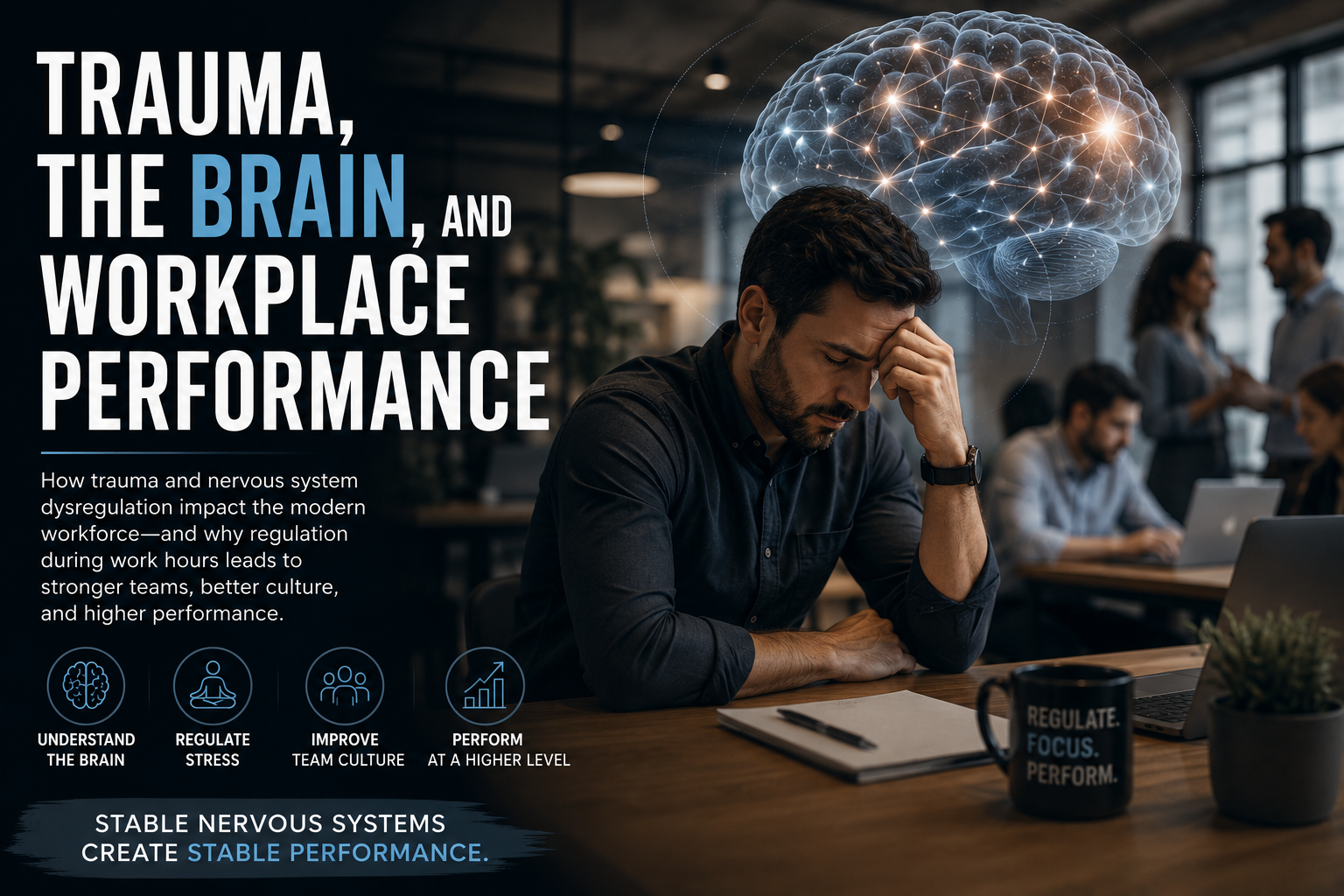
    Trauma, the Brain, and Workplace Performance

    Why Emotional Regulation May Be One of the Most Overlooked Variables in Modern Work Culture

    By Matthew F. Stevens

    For years, workplaces have focused heavily on outcomes.

    Metrics.
    Productivity.
    Attendance.
    Customer satisfaction.
    Performance scores.
    Revenue.

    But far fewer organizations stop to ask a deeper question:

    What condition is the nervous system in that is producing these outcomes?

    The truth is many workplaces are filled with intelligent, capable people operating from chronic stress states without even realizing it. What appears externally as laziness, disengagement, poor attitude, inconsistency, emotional reactivity, burnout, or lack of motivation is often something far deeper:

    An overloaded nervous system is struggling to regulate itself under pressure.

    Understanding trauma and nervous system regulation changed the way I viewed workplace culture forever.

    Because trauma does not only affect emotions.

    It affects the brain itself.

    And those changes directly influence how people communicate, perform, recover, solve problems, connect with coworkers, and respond under pressure.


    Trauma Is Far More Common Than Most People Realize

    Research has consistently shown that nearly 70% of adults will experience at least one traumatic event during their lifetime.

    And many experts believe younger generations are experiencing even higher levels of chronic stress exposure, instability, anxiety, social isolation, emotional overwhelm, and nervous system dysregulation than previous generations. Teenagers who lived during COVID are now a part of the workforce.

    Now consider this reality:

    These generations make up today’s workforce.

    The workplace is no longer simply managing skill sets and productivity.

    Organizations are managing human nervous systems operating under unprecedented levels of stress.

    People are showing up to work carrying:

    • childhood trauma
    • emotional neglect
    • financial pressure
    • relationship instability
    • chronic anxiety
    • burnout
    • overstimulation
    • nervous system exhaustion

    And most companies are still trying to solve these issues solely through pressure, coaching, accountability, or performance metrics.

    But nervous systems do not respond to pressure indefinitely.

    Eventually, they begin breaking down.


    How Trauma Impacts the Brain

    One of the biggest misconceptions about trauma is that people think it only affects memories or emotions.

    In reality, chronic stress and trauma can impact multiple areas of the brain responsible for decision-making, emotional control, threat detection, focus, motivation, and recovery.


    The Amygdala — The Threat Detection System

    The amygdala is heavily involved in detecting danger and emotional significance.

    When people experience chronic trauma or prolonged stress, the amygdala can become hyperactive.

    This means the nervous system begins scanning constantly for:

    • rejection
    • criticism
    • conflict
    • embarrassment
    • failure
    • disrespect
    • danger

    In workplaces, this can look like:

    • emotional overreactions
    • defensiveness
    • conflict escalation
    • difficulty handling feedback
    • chronic anxiety
    • interpersonal tension

    Many employees are not consciously trying to be difficult.

    Their nervous systems are simply operating as though threat is always nearby.


    The Prefrontal Cortex — Decision-Making and Emotional Control

    The prefrontal cortex helps with:

    • focus
    • planning
    • emotional regulation
    • impulse control
    • communication
    • decision-making

    But under chronic stress, this area becomes less accessible.

    This is why highly intelligent people can suddenly:

    • shut down under pressure
    • become emotionally reactive
    • struggle to focus
    • make impulsive decisions
    • overthink simple situations
    • lose confidence quickly

    In survival states, the brain prioritizes protection over clarity.

    That impacts workplace performance dramatically.


    The Hippocampus — Memory and Learning

    The hippocampus plays a major role in memory and learning.

    Chronic stress can impair how information is processed and stored.

    This often contributes to:

    • brain fog
    • forgetfulness
    • inconsistent performance
    • trouble retaining training
    • mental exhaustion

    Many employees silently blame themselves for these struggles without realizing their nervous systems may still be recovering from years of stress exposure.


    The Workforce Is Filled with Nervous Systems, Not Just Employees

    One thing I began noticing over time was this:

    People do not leave their nervous systems at home when they clock into work.

    They bring:

    • fear
    • insecurity
    • stress
    • trauma
    • survival adaptations
    • relationship pain
    • emotional exhaustion

    into every interaction.

    The modern workplace often treats performance as though human beings are machines.

    But human beings are biological systems first.

    And dysregulated systems create inconsistent outcomes.


    Healing Through Structure, Movement, and Connection

    Some of the greatest growth I experienced did not come from a textbook.

    It came through a simple human connection with coworkers like Drew and Brandon.

    Trips to the gym became more than workouts.

    They became a regulation.

    Movement.
    Connection.
    Structure.
    Consistency.
    Accountability.
    Stress release.

    Without fully realizing it at first, we were creating moments of nervous system recovery inside the middle of stressful work environments.

    The gym gave us:

    • emotional decompression
    • camaraderie
    • discipline
    • emotional processing
    • confidence
    • healthy stress release

    And over time, those moments created real emotional growth.

    This is one of the biggest things modern workplaces often overlook:

    Regulated connection changes people.

    Not pressure.
    Not shame.
    Not endless motivation.

    Connection.
    Consistency.
    Recovery.


    Leadership and Psychological Safety Matter

    One moment that stood out to me deeply was when Eric, the Vice President of our company, invited several of us into a sit-down discussion about workplace culture.

    What mattered was not just the meeting itself.

    It was what the meeting represented.

    People felt heard.

    Leadership listened.

    Questions were asked.

    Experiences were acknowledged.

    That matters more than many organizations realize.

    Because workplace culture is not built only through policies.

    It is built through nervous system experiences.

    Employees remember:

    • whether leadership listens
    • how managers respond under stress
    • whether communication feels safe
    • whether they feel disposable or valued
    • whether pressure is balanced with support

    Leadership directly impacts regulation inside organizations.

    And regulated teams communicate differently.


    Why ORS™ Was Created

    One of the biggest realizations of my life was understanding this:

    Stable nervous systems create more stable performance.

    That realization eventually led me to begin developing ORS™ (Operational Regulation Systems).

    ORS™ was built around a simple but powerful concept:

    If chronic stress and nervous system dysregulation are impacting workplace performance, then regulation itself must become part of the operational environment.

    Not as therapy.

    Not as motivation.

    But as a structured nervous system conditioning integrated into the workday itself.

    The purpose is simple:

    • help employees recover faster
    • reduce emotional escalation
    • improve consistency
    • improve focus
    • reduce nervous system overload
    • stabilize performance under pressure

    Testing Regulation in Real Time

    Over time, I began informally testing regulation concepts with coworkers inside real workplace environments.

    Not through lectures.

    Not through theory alone.

    But through practical nervous system regulation tools, structured recovery moments, mindset shifts, movement, breathing, awareness, and behavioral consistency.

    What I repeatedly observed was this:

    When people became more regulated:

    • communication improved
    • emotional reactions lowered
    • confidence stabilized
    • focus improved
    • stress recovery became faster
    • workplace interactions became healthier

    People often did not need more pressure.

    They needed nervous system recovery.


    Final Thoughts

    The future of workplace performance may depend far more on nervous system regulation than most organizations currently realize.

    Trauma and chronic stress do not stay outside workplace walls.

    They quietly influence:

    • communication
    • teamwork
    • leadership
    • morale
    • productivity
    • burnout
    • emotional control
    • consistency

    And as younger generations carrying unprecedented levels of stress continue entering the workforce, organizations that ignore nervous system regulation may increasingly struggle with instability, burnout, turnover, and emotional exhaustion.

    But when workplaces begin prioritizing:

    • regulation
    • structure
    • recovery
    • connection
    • psychological safety
    • healthy leadership

    something powerful happens.

    People stop functioning from survival.

    And begin functioning from stability.


    About the Author

    Matthew F. Stevens is the creator of ORS™ (Operational Regulation Systems), founder of NALS™ (Neuro Advanced Learning Systems), and host of the EQ Unlocked podcast focused on emotional regulation, nervous system stability, and workplace performance under pressure.

    Additional research on how chronic stress impacts the brain and body can be found through the American Psychological Association.

    Listen to EQ Unlocked:
    https://eq.matthewfstevens.com

    Take the Regulation Baseline Assessment:
    https://matthewfstevens.com/find-your-regulation-baseline/

  • Structure, Consistency, and Stability: The Foundation of Emotional Regulation and Performance

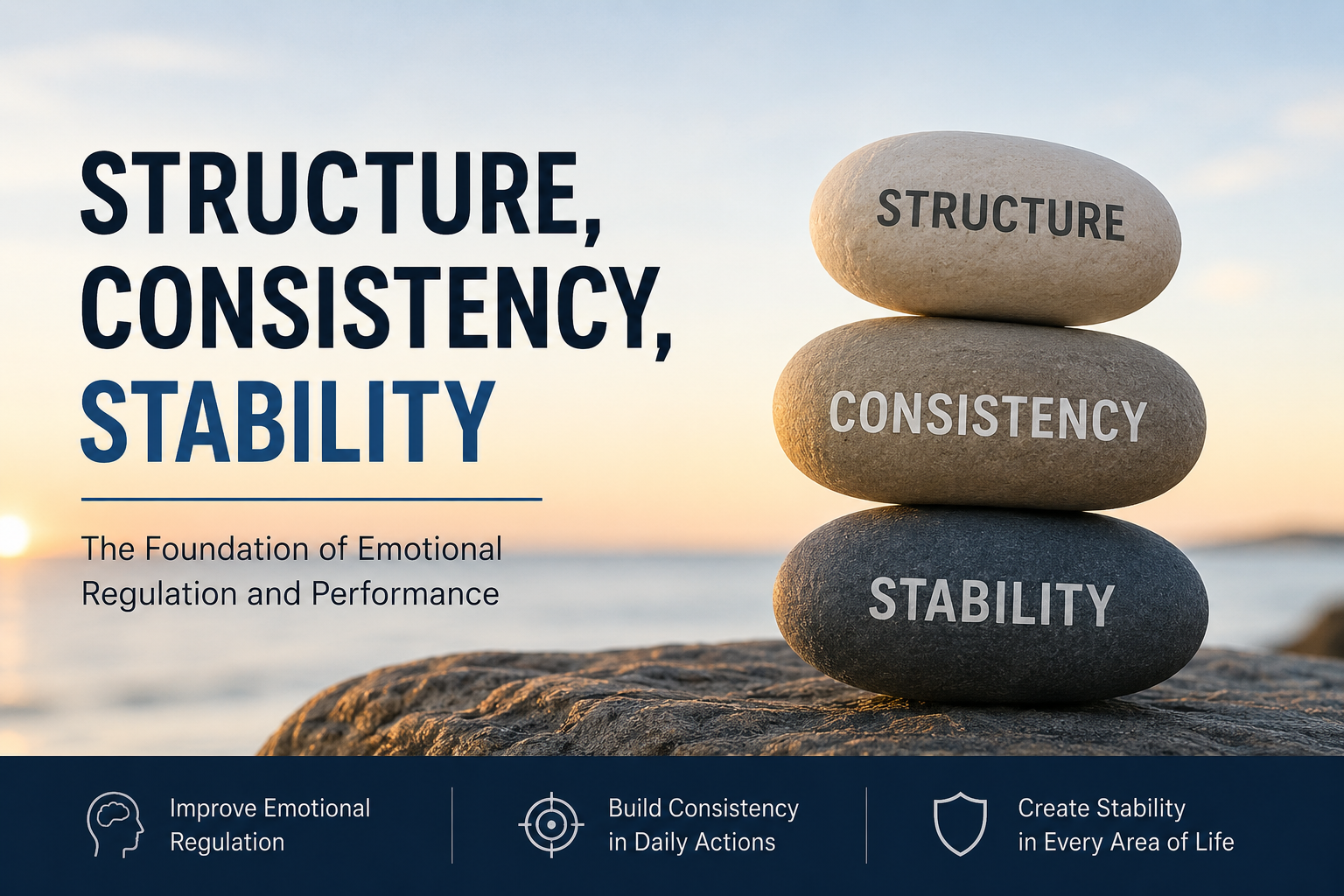
    Structure, Consistency, and Stability: The Foundation of Emotional Regulation and Performance

    In a world obsessed with motivation, productivity, and performance, many people are overlooking the very thing that determines whether long-term growth is sustainable:

    Stability.

    Without stability, consistency becomes difficult.
    Without consistency, structure collapses.
    And without structure, performance becomes unpredictable.

    This pattern appears everywhere.

    It appears in workplaces struggling with burnout and turnover.
    It appears in relationships overwhelmed by emotional reactivity.
    It appears in individuals who want to change their lives but repeatedly fall back into destructive habits despite their best intentions.

    The problem is often not intelligence, talent, or desire.

    The problem is nervous system instability.

    Why Stability Matters

    Human beings perform best when the nervous system feels safe enough to remain present, focused, and adaptable under pressure.

    When the nervous system becomes chronically dysregulated, survival mechanisms begin taking control. People become reactive instead of intentional. Small stressors feel overwhelming. Emotional responses intensify. Focus deteriorates. Recovery slows.

    Over time, this creates inconsistency in behavior, communication, and decision-making.

    This is why stability is not weakness.

    Stability is strength.

    A stable nervous system creates the foundation necessary for emotional regulation, critical thinking, discipline, and healthy relationships.

    Structure Creates Predictability

    Structure helps reduce unnecessary chaos.

    Consistent routines, expectations, sleep patterns, communication habits, recovery practices, and environments create predictability for the nervous system. Predictability lowers stress load and increases emotional accessibility.

    This is one reason highly successful individuals often rely on structure.

    Structure is not about rigidity.

    It is about reducing internal friction.

    When people remove unnecessary instability from their lives, they conserve energy for growth, leadership, creativity, and problem-solving.

    Without structure, many people spend their lives emotionally reacting to preventable stressors.

    Consistency Builds Trust

    Consistency is one of the most misunderstood aspects of personal growth.

    Many people believe consistency means perfection.

    It does not.

    Consistency means repeatedly returning to alignment even after setbacks, stress, discomfort, or emotional activation.

    Real consistency is recovery.

    It is the ability to stabilize yourself and continue moving forward without abandoning the process every time life becomes difficult.

    This applies to:

    • Emotional regulation
    • Leadership
    • Parenting
    • Relationships
    • Business performance
    • Physical health
    • Mental health
    • Personal development

    The people who create lasting transformation are rarely the people who never struggle.

    They are usually the people who continue returning to structure despite struggle.

    Emotional Regulation and Stability

    One of the greatest misconceptions about emotional intelligence is the belief that awareness alone creates change.

    Awareness without regulation often increases suffering.

    A person can become deeply aware of their patterns while still lacking the nervous system stability necessary to interrupt those patterns under pressure.

    This is why emotional regulation matters.

    Regulation allows the brain and body to recover from activation more effectively. It increases access to reasoning, communication, emotional control, and intentional decision-making.

    When regulation improves:

    • Recovery speed improves
    • Communication improves
    • Decision-making improves
    • Performance stabilizes
    • Emotional reactivity decreases
    • Behavioral consistency increases

    Over time, this creates a stronger internal foundation.

    The Hidden Link Between Stability and Performance

    Many organizations focus heavily on outcomes while ignoring the nervous systems producing those outcomes.

    Companies track:

    • Productivity
    • Turnover
    • Escalations
    • Attendance
    • Customer satisfaction
    • Performance metrics

    But few stop to ask:

    What internal conditions are driving behavioral inconsistency?

    A dysregulated workforce often produces:

    • Higher emotional escalation
    • Increased burnout
    • Poor communication
    • Reduced adaptability
    • Performance variability
    • Increased conflict

    Meanwhile, stable teams recover faster under stress and maintain performance more consistently during pressure.

    The same principle applies to individuals.

    Performance is rarely sustained through pressure alone.

    Long-term performance is built through regulation, structure, consistency, and stability.

    Final Thoughts

    The goal is not perfection.

    The goal is stability strong enough to continue growing under pressure.

    Structure creates predictability.
    Consistency reinforces trust.
    Stability strengthens performance.

    Over time, these principles reshape identity itself.

    This is why emotional regulation is not simply about feeling better.

    It is about becoming more accessible to growth, discipline, leadership, connection, and long-term transformation.

    Because when the nervous system stabilizes, people begin making choices from clarity instead of survival.

    To further explore the connection between emotional regulation, awareness, and long-term performance, the American Psychological Association provides valuable insight into emotional processes and behavioral health at https://www.apa.org/topics/emotions. You can also explore your own emotional regulation baseline through the Regulation Baseline Assessment available at https://matthewfstevens.com/find-your-regulation-baseline/, designed to help individuals better understand recovery speed, stress response patterns, and behavioral consistency under pressure.

  • Emotional Intelligence Is the Missing Variable Behind Workplace Performance

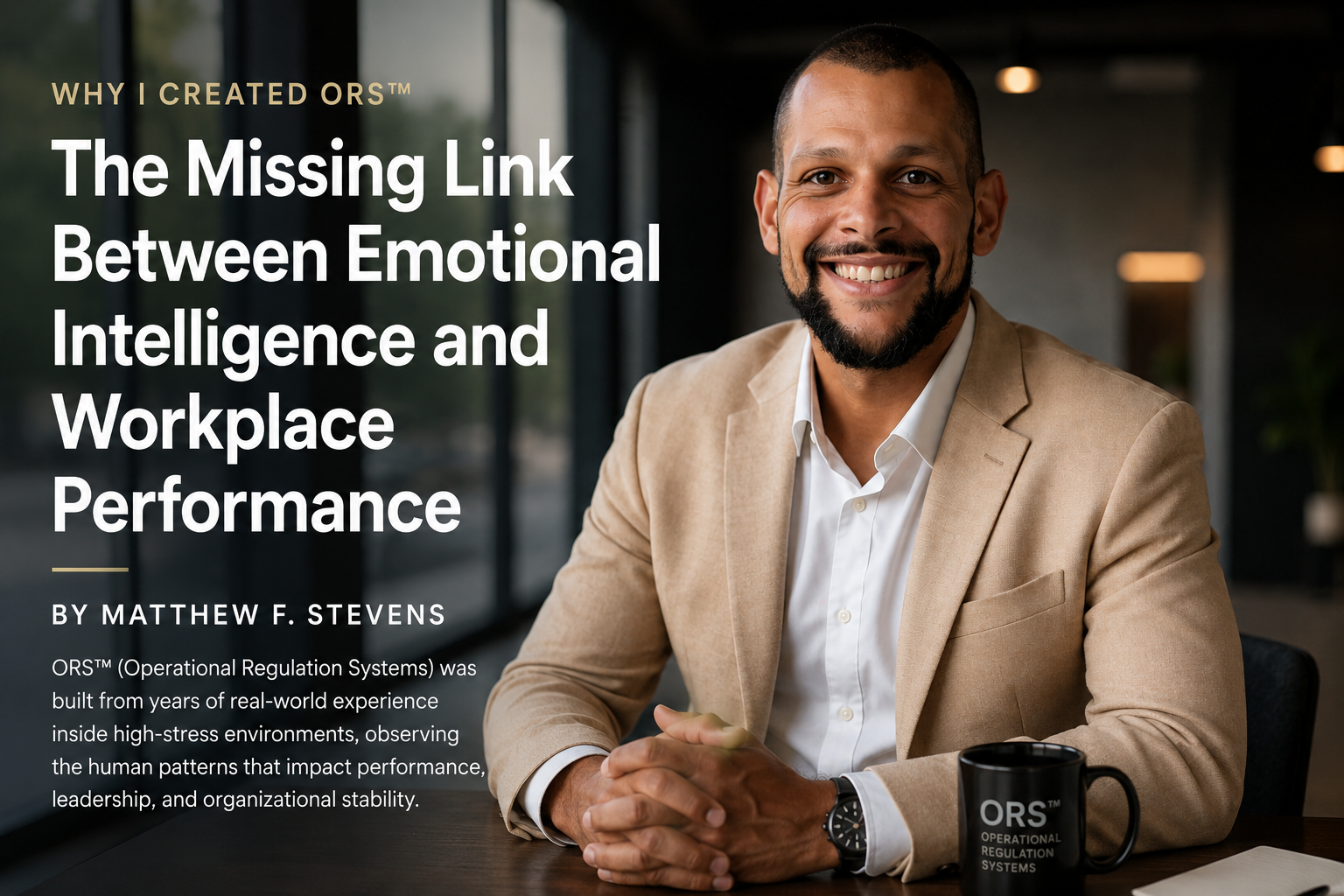
    Emotional Intelligence Is the Missing Variable Behind Workplace Performance

    For years, I watched organizations focus on productivity, compliance, engagement, and performance while overlooking one of the most important drivers of human behavior:

    Emotional intelligence.

    Not emotional intelligence as a buzzword.
    Not motivational posters or corporate slogans.

    Real emotional intelligence.

    The ability to regulate emotions, recover under pressure, communicate effectively, maintain self-awareness, and make sound decisions during stress.

    Research and leadership literature from sources like Harvard Business Review has increasingly highlighted the role emotional intelligence plays in leadership, communication, and organizational performance.

    What I eventually realized was this:

    Most performance problems are not intelligence problems.

    They are emotional intelligence problems.

    That realization became the foundation for ORS™ (Operational Regulation Systems).

    I did not develop ORS™ from theory alone. I developed it through years of firsthand experience across multiple industries and high-stress environments.

    For most of my adult life, I worked helping children and families in emotionally intense situations. Over time, I witnessed the direct relationship between emotional regulation and human behavior.

    Children struggling with emotional regulation often displayed:

    • impulsive behavior
    • emotional reactivity
    • poor decision-making
    • instability under stress

    But the deeper insight came later.

    I began noticing many adults — including leadership teams, employees, and professionals — were struggling with the exact same underlying issues.

    Different age.
    Different environment.
    Same human mechanism.

    Over the years, I worked across multiple industries including:

    • youth services
    • residential treatment
    • manufacturing
    • customer service
    • construction
    • financial services

    Everywhere I went, I observed the same operational pattern:

    People were attempting to perform under chronic stress without the emotional intelligence skills necessary to regulate themselves effectively.

    I watched organizations struggle with:

    • burnout
    • absenteeism
    • communication breakdowns
    • workplace conflict
    • emotional exhaustion
    • inconsistent performance
    • high stress environments
    • poor recovery after pressure

    The issue was rarely a lack of capability.

    The issue was emotional regulation.

    Most people had never been taught how to:

    • regulate stress
    • recover emotionally
    • increase self-awareness
    • interrupt reactive behavior
    • improve emotional control under pressure

    Emotional Intelligence in the Workplace: Leadership, Stress, and Performance

    Eventually I began to understand something important:

    Emotional intelligence is not separate from performance.

    It drives performance.

    The most significant turning point came while working inside a global financial institution.

    I watched employees emotionally overwhelmed on a daily basis while leadership attempted to improve morale through surface-level engagement strategies that failed to address the deeper issue affecting the workforce.

    Then one of my coworkers died by suicide.

    Before his death, he openly communicated emotional pain to people around him, but many lacked the emotional awareness to fully recognize the severity of what he was experiencing.

    That moment permanently changed how I viewed emotional intelligence.

    I realized emotional intelligence was not simply about leadership development or communication skills.

    It was directly connected to human wellbeing, emotional recovery, workplace stability, and long-term performance sustainability.

    Around the same time, I watched employees sitting in parking lots crying after work.

    Something was clearly missing.

    Not only at the individual level, but within the systems themselves.

    That realization accelerated the development of ORS™.

    I began testing emotional regulation strategies on myself first.

    The results were measurable:

    • improved emotional regulation
    • increased emotional intelligence
    • stronger communication
    • improved self-awareness
    • faster recovery after stress
    • improved consistency under pressure
    • better decision-making

    After experiencing those improvements personally, I began testing ORS™ principles with other employees.

    The feedback remained remarkably consistent.

    Employees reported:

    • improved emotional awareness
    • better workplace communication
    • reduced emotional reactivity
    • stronger stress management
    • improved workplace relationships
    • increased consistency under pressure

    What became clear was simple:

    Emotional intelligence is not optional in high-stress environments.

    It is foundational.

    ORS™ was built from years of observing the same problem repeatedly across multiple industries:

    People struggle to perform consistently when emotional regulation is absent.

    Different industries.
    Different people.
    Same human mechanism.

    If you’re interested in learning how emotional intelligence and nervous system regulation impact workplace performance, leadership, and consistency under pressure, explore ORS™ at MatthewFStevens.com.

    Regulation → Awareness → Choice.

    — Matthew F. Stevens

  • Emotional Intelligence Starts With Regulation

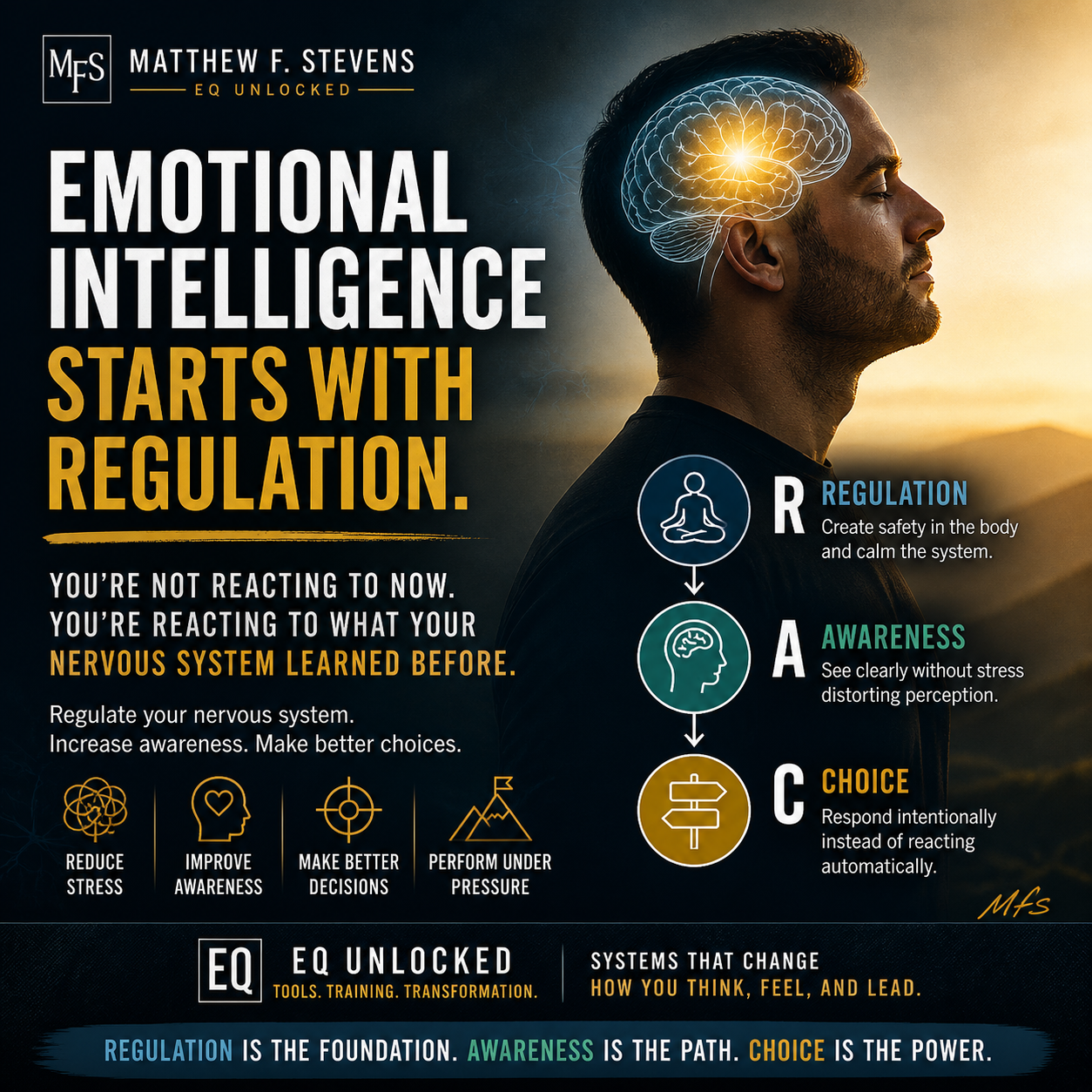
    Emotional Intelligence Starts With Regulation

    Most people think emotional intelligence is about communication skills, staying calm, or learning how to “manage emotions.”

    But emotional intelligence begins much deeper than behavior.

    It begins with regulation.

    Before someone can communicate clearly, make healthy decisions, or respond intentionally under pressure, their nervous system has to feel safe enough to allow awareness to exist without becoming overwhelmed.

    That changes everything.

    Why People Repeat the Same Patterns

    Many people are not reacting to the present moment.

    They are reacting to what their nervous system learned through repeated experiences over time.

    Stress. Rejection. Chaos. Criticism. Instability. Fear.

    Over time, the body learns survival patterns:

    • shutting down
    • overreacting
    • people pleasing
    • emotional withdrawal
    • anger
    • avoidance
    • hypervigilance
    • impulsive decision-making

    These responses are often mislabeled as personality flaws when they are actually conditioned nervous system responses.

    You cannot build lasting emotional intelligence while your body still believes survival is the priority.

    Awareness Without Regulation Can Feel Overwhelming

    This is where many people struggle.

    They become aware of their patterns, trauma, triggers, or behaviors—but awareness alone does not create change.

    In fact, awareness without regulation often increases shame, anxiety, frustration, or emotional flooding.

    That is why the order matters:

    REGULATION → AWARENESS → CHOICE

    When the nervous system becomes more regulated:

    • reactions slow down
    • thinking becomes clearer
    • self-awareness improves
    • communication changes
    • behavior becomes more intentional

    The goal is not emotional perfection.

    The goal is to create enough internal stability to choose differently rather than react automatically.

    Emotional Intelligence Is Built Through Repetition

    Real emotional intelligence is not built through motivation alone.

    It is built through repeated experiences that teach the nervous system:

    • safety
    • consistency
    • self-respect
    • accountability
    • emotional recovery
    • pause before reaction

    Small repeated behaviors reshape baseline responses over time.

    This is why consistency matters more than intensity.

    Tiny repeated choices:

    • taking a breath before reacting
    • pausing instead of escalating
    • communicating clearly
    • maintaining boundaries
    • following through on commitments
    • staying present under stress

    gradually recondition the nervous system.

    That is how emotional intelligence becomes embodied instead of intellectual.

    Emotional Intelligence Changes Every Area of Life

    When regulation improves, people often notice changes in:

    • relationships
    • leadership
    • parenting
    • performance under pressure
    • confidence
    • discipline
    • communication
    • self-respect

    Not because they became a different person overnight—
    but because they stopped operating from constant survival mode.

    A dysregulated nervous system distorts perception.

    A regulated nervous system increases clarity.

    Emotional intelligence impacts every area of life—from leadership and communication to stress management, relationships, and decision-making under pressure. Publications like Forbes continue emphasizing emotional intelligence as a critical factor in both personal and professional success.

    The Future of Emotional Intelligence

    The future of emotional intelligence is not just learning how to think differently.

    It is learning how to regulate differently.

    The more we understand the relationship between the nervous system, behavior, awareness, and decision-making, the more we realize:

    People are not weak because they struggle.

    Many have never learned regulation.

    And once regulation improves, awareness sharpens.

    When awareness sharpens, choices change.

    That is where transformation begins.

    Get your regulation baseline assessment here.


    Matthew F. Stevens
    Founder of NALS™, ORS™, and EQ Unlocked
    Helping individuals and organizations build emotional intelligence through nervous system regulation and structured behavioral systems.

  • Taking Responsibility for Your Life: Why It Starts with Your Nervous System

    Taking Responsibility for Your Life: Why It Starts with Your Nervous System

    Most people believe taking responsibility for your life means working harder, thinking differently, or holding yourself accountable.

    But if that were true, change would be easy.

    You would decide once—and follow through.

    That’s not what happens.

    You start strong. You have clarity. You know what needs to change.

    And then something shifts.

    You fall back into the same patterns, the same reactions, and the same outcomes.

    That’s not a character flaw.

    That’s a regulation problem.


    Why Taking Responsibility Feels So Difficult

    Taking responsibility requires one thing most people don’t have:

    👉 The ability to stay regulated under pressure

    Because responsibility isn’t just about what you know—it’s about what you can do in the moment.

    When your nervous system is dysregulated:

    • Your thinking becomes reactive
    • Your emotions become amplified
    • Your decisions become inconsistent

    You don’t act based on your values.

    You act based on your state.

    A Personal Example: What Responsibility Used to Look Like

    Before I understood how my nervous system was shaping my behavior, I approached responsibility the way most people do—through effort, pressure, and trying to force change.

    This video reflects that version of me. The message still holds value, but it’s incomplete.

    What I understand now is this:

    Responsibility isn’t just a decision—it’s a capacity.

    If your nervous system isn’t regulated, even the strongest intentions won’t hold when pressure shows up.


    The Truth Most People Avoid

    You don’t avoid responsibility because you don’t care.

    You avoid responsibility because:

    👉 Responsibility requires discomfort—and your system is trained to escape it

    That escape shows up as:

    • Procrastination
    • Blame
    • Justification
    • Distraction

    Not because you’re weak…

    But because your body is trying to return to what feels familiar.


    Why You Keep Repeating the Same Patterns

    You’ve probably said this before:

    “I know what to do… I just didn’t do it.”

    That’s the gap between:

    • Awareness
    • Action

    And that gap is filled by your nervous system.

    If you’re not regulated:

    • You can’t pause
    • You can’t choose
    • You can’t follow through

    Responsibility Isn’t Mental—It’s Physiological

    This is where everything shifts.

    Taking responsibility is not:

    • Forcing yourself
    • Thinking positively
    • Trying harder

    It’s:

    👉 Building the capacity to stay present and act under pressure

    Because when you’re regulated:

    • You slow down
    • You think clearly
    • You respond intentionally

    That’s where responsibility lives.


    How to Start Taking Responsibility for Your Life

    Not all at once. Not perfectly.

    Start here:

    1. Regulate Before You React

    Before making a decision, ask:

    “Am I regulated right now?”

    If not, pause.


    2. Shrink the Moment

    Don’t try to fix your life.

    Focus on:
    👉 The next decision

    Responsibility is built in small, repeatable actions.


    3. Stop Escaping Discomfort

    Notice when you:

    • Avoid
    • Distract
    • Delay

    That’s your nervous system trying to leave the moment.

    Stay instead.


    4. Focus on Recovery, Not Perfection

    You will react.

    The difference is:
    👉 How quickly you return to baseline

    That’s where growth happens.


    The Shift That Changes Everything

    You don’t take responsibility by becoming a different person.

    You take responsibility by becoming someone who can:

    👉 Stay in the moment long enough to choose differently

    Final Thought

    Taking responsibility for your life isn’t about control.

    It’s about capacity.

    The capacity to:

    • Stay present
    • Stay regulated
    • Stay aligned with your values

    Because when you can stay…

    You can finally follow through. Here is a great read I found on the connection between happiness and responsiblity Home | Journal of Happiness Studies | Springer Nature Link


    If you want to understand where your current baseline is and why you struggle to follow through:

    👉 Take the Regulation Baseline Assessment:
    https://matthewfstevens.com/find-your-regulation-baseline/

  • How Your Nervous System Is Running Your Life (And You Don’t Even See It)

    How Your Nervous System Is Running Your Life (And You Don’t Even See It)

    You don’t wake up thinking about your nervous system. Your nervous system is running your life in ways you don’t even realize.

    You wake up thinking about your day—what needs to get done, who you need to talk to, what you need to handle.

    But before any of that…

    Your nervous system has already decided how that day is going to feel.

    • Whether you’ll feel calm or on edge
    • Whether you’ll trust or question
    • Whether you’ll respond or react

    Most people believe their lives are shaped by what’s happening around them.

    It’s not.

    It’s shaped by how their nervous system interprets what’s happening.

    And most people aren’t even aware that it’s happening.


    Your Nervous System Is Always Working—With or Without You

    Your nervous system is constantly scanning your environment.

    Not for success.
    Not for happiness.

    For safety.

    It’s asking one question, over and over:

    “Am I safe right now?”

    And it doesn’t answer that question using logic.

    It answers it using pattern recognition.

    • “This feels familiar.”
    • “I’ve felt this before.”
    • “Last time this happened, it didn’t go well.”

    So it responds quickly.

    Automatically.

    Before you have time to think about it.


    Why Your Reactions Feel Automatic

    Have you ever:

    • Reacted faster than you wanted to?
    • Said something and immediately regretted it?
    • Felt overwhelmed in a moment that didn’t seem that serious afterward?

    That’s not a lack of discipline.

    That’s your nervous system doing exactly what it was trained to do.

    Your brain prioritizes speed over accuracy.

    Because in a survival-based system, being fast matters more than being right.

    So your body activates first:

    • Your chest tightens
    • Your thoughts narrow
    • Your reactions speed up

    Then your mind steps in and tries to explain it.

    “They disrespected me.”
    “Something’s off.”
    “I need to fix this right now.”

    But those thoughts are often justifications of a state, not reflections of reality.


    How Your Nervous System Is Running Your Life Without You Realizing It

    Most people believe they think their way into reactions.

    But in reality, it works like this:

    Body → Reaction → Thought

    Your body shifts.

    Then you react.

    Then your mind explains why.

    • Tightness → “Something’s wrong.”
    • Silence → “I’m being ignored.”
    • Tone shift → “They’re upset with me.”

    Those thoughts feel true.

    But they are often based on how you feel, not what’s actually happening.

    You’re not reacting to the situation.
    You’re reacting to your state in the situation.


    Where This Training Comes From

    Your nervous system wasn’t built in a vacuum.

    It was shaped by experience.

    The environments you were in…
    The patterns you were exposed to…
    The moments where you had to adapt quickly…

    All of it trained your system.

    For some people, that training created:

    • Hyper-awareness
    • Fast reactions
    • Strong emotional responses

    Not because something is wrong with them.

    Because their system learned:

    “This is how I stay safe.”

    The problem is…

    That training doesn’t turn off when your environment changes.


    How It Shows Up in Your Daily Life

    This isn’t abstract.

    It shows up in real, everyday moments.

    In your reactions:

    • You respond faster than you intend
    • You escalate before you understand

    In your relationships:

    • You assume intent
    • You become defensive
    • You over-explain or shut down

    In your decisions:

    • You choose relief over clarity
    • You avoid uncertainty
    • You second-guess yourself

    And often, afterward, you think:

    “Why did I do that?”

    Because your nervous system was leading.


    Why Awareness Alone Doesn’t Change It

    Most people try to fix this by thinking differently.

    • “I need to be more aware.”
    • “I need to control my emotions.”
    • “I need to make better choices.”

    But here’s the problem:

    You don’t have access to better thinking when your system is activated.

    When your nervous system is in a heightened state:

    • Your perspective narrows
    • Your patience drops
    • Your reactions speed up

    So even if you know better…

    You don’t have access to better.


    The Shift That Changes Everything

    This is where most people get it wrong.

    They try to fix behavior before they fix state.

    But the real shift is this:

    Regulation → Awareness → Choice

    When you regulate your nervous system:

    • Your body calms
    • Your perception changes
    • Your thinking expands

    Now you can:

    • Understand what you’re feeling
    • See the situation clearly
    • Choose your response

    Not because you forced it.

    Because you finally have access to it.


    What This Looks Like in Real Life

    Instead of reacting immediately:
    You pause.

    Instead of assuming:
    You get curious.

    Instead of escalating:
    You stabilize.

    You don’t eliminate emotion.

    You stop being controlled by it.


    The Identity Shift

    You are not:

    • Too emotional
    • Too reactive
    • Too sensitive

    You are trained.

    And what has been trained can be retrained.

    But only if you stop trying to fix the outcome…

    And start working with the system that’s creating it.

    www.ItsPureLove.com is another wonderful resource for rebooting your operating system.


    Closing

    Your nervous system is not just influencing your life.

    It’s shaping how you experience it.

    In your reactions.
    In your relationships.
    In your decisions.

    And until you understand how it operates…

    It will continue to run your life without you realizing it.

    But the moment you begin to regulate your system…

    Is the moment you begin to take control back.

    If you want to understand where your nervous system is currently operating:

    👉 Take your Regulation Baseline Assessment:
    https://matthewfstevens.com/find-your-regulation-baseline/

  • Why You Don’t Need Closure to Move Forward

    Why You Don’t Need Closure to Move Forward

    There was a time when I believed I needed closure.

    I needed the conversation.
    I needed to explain myself.
    I needed the other person to understand what actually happened.

    Because if they understood…
    then everything would settle.

    That belief kept me stuck longer than anything else.


    The Truth About Closure

    Closure sounds healthy.

    It sounds mature.

    But most of the time, it’s not about resolution.

    It’s about control.

    It’s the attempt to organize something that feels chaotic.
    To make sense of something that doesn’t feel fair.
    To create a clean ending where one doesn’t exist.

    The problem is—people don’t always give you that.

    And when they don’t, most people don’t move forward.

    They go back.


    What I Started to Notice

    Every time I felt the need for closure, the same pattern showed up.

    My mind would start scanning:

    • replaying conversations
    • analyzing tone, timing, intention
    • trying to figure out where it went wrong

    Not once.

    Over and over again.

    And it felt productive.

    It felt like I was “working through it.”

    But I wasn’t.

    I was trying to regain control of how I was being perceived.


    This Was the Real Trigger

    It wasn’t the situation.

    It was the feeling of being misunderstood.

    That’s what activated everything.

    Because when someone misunderstands you, your system wants to correct it.

    To explain.
    To defend.
    To be seen accurately.

    But here’s the truth I had to face:

    You can explain yourself perfectly…
    and still be misunderstood.


    Why Closure Doesn’t Work

    Even when you get the conversation…

    Even when you say everything you wanted to say…

    Even when they respond…

    It rarely gives you what you thought it would.

    Because the issue was never just the conversation.

    It was your nervous system trying to settle.

    And no amount of explanation can regulate a dysregulated system.


    The Shift That Changed Everything

    At some point, I stopped asking:

    “How do I get closure?”

    And I started asking:

    “Did I handle myself with integrity?”

    That changed everything.

    Because now the focus wasn’t on them.

    It was on me. I came to understand the power of responsibility.


    What Real Closure Actually Is

    Closure isn’t something you receive.

    It’s something you decide.

    It sounds like this:

    “I showed up. I was honest. I stayed aligned. I’m done engaging.”

    That’s it.

    No final conversation required.

    No agreement needed.

    No perfect ending.


    Regulation Before Resolution

    Everything I teach comes back to this:

    Regulation → Awareness → Choice

    When you’re dysregulated:

    • you chase answers
    • you replay conversations
    • you try to fix perception

    When you’re regulated:

    • you can sit with discomfort
    • you don’t need to prove your point
    • you don’t need the other person to agree

    You can move forward without everything being resolved.


    The Cost of Going Back

    Every time you revisit it:

    • mentally
    • emotionally
    • conversationally

    You reinforce the loop.

    You teach your system:

    “We’re not okay until this is fixed.”

    That’s not strength.

    That’s dependency.


    What I Do Now

    When my mind starts scanning the past, I don’t follow it.

    I don’t try to solve it.

    I don’t try to get clarity.

    I tell myself:

    “I’ve already handled this.”

    And I move forward.

    Not because it feels perfect.

    But because I’ve decided it’s complete.


    A New Standard

    Most people ask:

    “Did I get closure?”

    I ask:

    “Did I stay aligned with who I’m becoming?”

    That’s the only standard that matters.


    Final Thought

    Not everything will be resolved.

    Not everyone will understand you.

    Not every situation will make sense.

    And you can still move forward.


    Regulation → Awareness → Choice

    That’s the path.


    Conversations With Others

    One thing I’ve come to understand is that while closure isn’t required to move forward, there are tools that can support how we experience that process.

    In my recent conversation with Thayne Martin of itspurelove.com, he introduced the idea of what he calls a “gratitude cocktail”—a way of shifting internal state through intentional focus and emotional redirection.

    Where my work emphasizes regulation as the gateway to awareness and choice, his perspective adds another layer to the conversation around how people can begin to access different emotional states.

    These conversations matter.

    Because growth doesn’t come from one idea—it comes from understanding how different approaches connect, where they work, and where they don’t.

    If you’re exploring your own path, I encourage you to listen, evaluate, and apply what actually creates change for you.

    I encourage you Find your regulation baseline

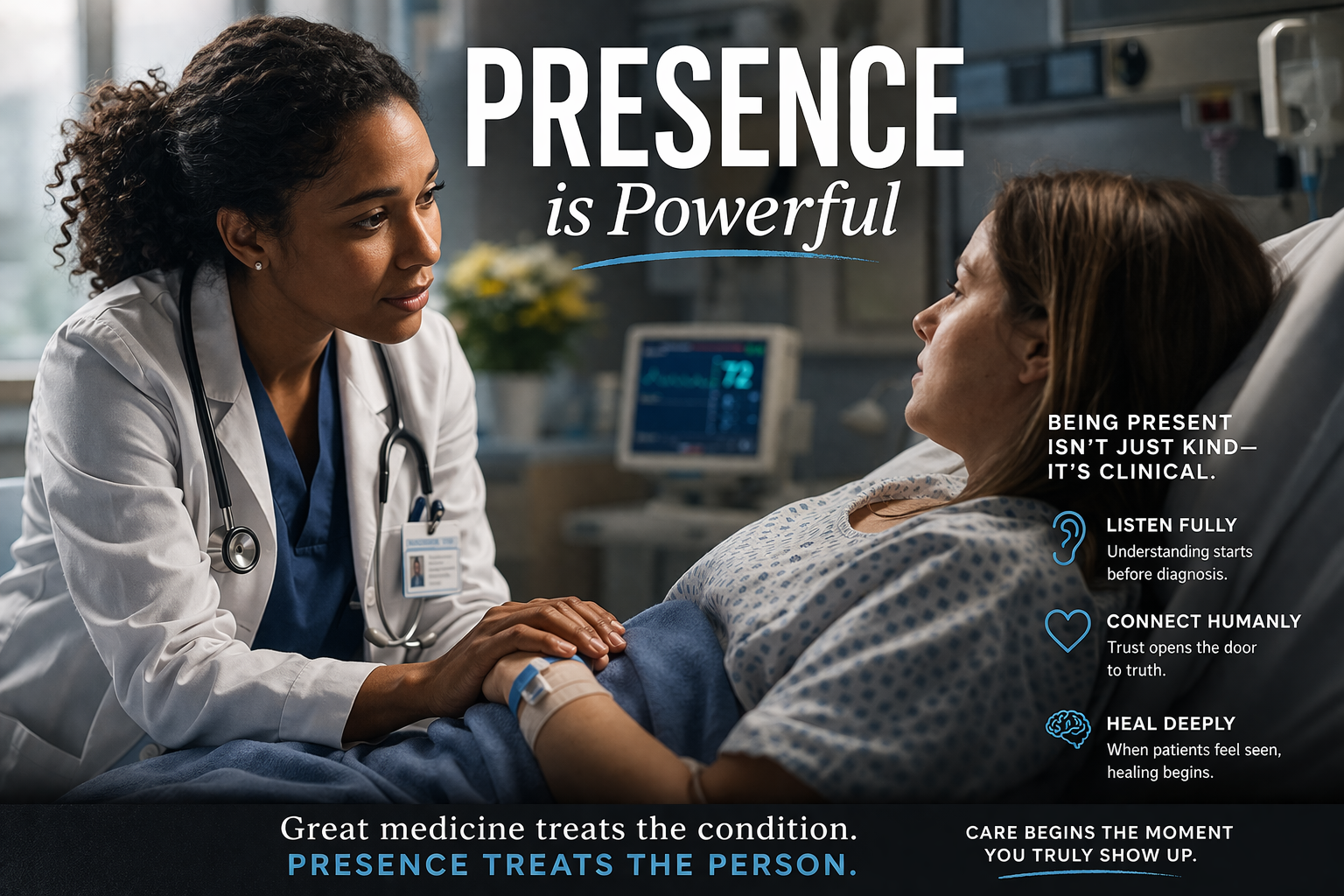
  • When Medical Professionals Default to Assumption Instead of Understanding

    When Medical Professionals Default to Assumption Instead of Understanding

    Recently, I took a friend to the ER after she fell down a set of stairs.

    The doctor was dismissive.
    Not aggressive. Not rude. Just… uninterested.

    And to be fair—I understand the pressure.

    Emergency rooms are high-stress environments.
    Decisions are fast. Time is limited. Volume is constant.

    But here’s the problem:

    Pressure does not excuse disconnection.

    Because when a patient feels dismissed, they stop listening.
    And when they stop listening, care breaks down.


    The Hidden Problem in Doctor-Patient Communication

    This wasn’t an isolated experience.

    I’ve seen it before—and I’ve experienced it myself.

    Medical professionals often focus on the presenting problem:

    • The injury
    • The symptom
    • The immediate concern

    But they miss something just as important:

    What brought the person there in the first place.

    Instead of listening, the interaction becomes transactional—efficient, but disconnected.

    And for someone with a trauma history, that moment lands differently.

    It doesn’t feel efficient.

    It feels like dismissal.

    This is where doctor-patient communication begins to break down—especially when trauma-informed care in healthcare is missing.


    Why Trauma-Informed Care in Healthcare Matters

    Trauma-informed care in healthcare is not just about being kind—it’s about understanding how past experiences shape present behavior.

    When patients feel unsafe, unheard, or judged, their nervous system responds.

    They shut down.
    They withhold information.
    They disconnect.

    Without trauma-informed care, providers risk treating symptoms while missing the underlying cause. More about this issue https://pmc.ncbi.nlm.nih.gov/articles/PMC4910305/?utm_source=chatgpt.com


    How Dysregulation Impacts Patient Outcomes

    Let’s call it what it is.

    This isn’t a knowledge problem.
    This is a regulation problem.

    When a medical professional is under constant pressure, their nervous system adapts.

    It prioritizes:

    • Speed
    • Task completion
    • Throughput

    And slowly, without intention, something gets lost:

    Presence.

    Dysregulation doesn’t always look chaotic.

    Sometimes it looks like efficiency without connection.

    Internally, it sounds like:

    • “I don’t have time for this.”
    • “Let’s get to the point.”
    • “What’s the issue?”

    But to the patient, it translates to:

    “I don’t matter.”


    The Cost of Assumption in Medical Settings

    When people don’t feel heard, they don’t open up.

    They withdraw.
    They shorten their answers.
    Or they become frustrated.

    Either way—the real issue stays hidden.

    In this case, yes—my friend injured her ankle.

    But that wasn’t the full story.

    She had been dealing with a severe cough for weeks.
    She had seen multiple providers.
    She had been given multiple medications.

    None of them worked.

    The actual issue?

    An infection that required a completely different approach.

    We almost missed it.

    Not because of a lack of knowledge—

    Because of a lack of connection.


    Regulation: The Missing Link in Patient Centered Care

    Medical training builds knowledge.
    Experience builds pattern recognition.

    But neither matter if they aren’t accessible under stress.

    Nervous system regulation in healthcare is what makes both usable.

    When providers operate from a regulated baseline:

    • They listen instead of rush
    • They get curious instead of assume
    • They connect before they diagnose

    Even something simple—like reflecting a patient’s words back—can transform the interaction.

    This is the foundation of true patient-centered care.


    Improving Healthcare Communication Through Regulation

    Stress in healthcare isn’t going away.

    But how it’s handled?

    That’s trainable.

    When regulation improves:

    • Doctor-patient communication improves
    • Diagnosis becomes more accurate
    • Patient trust increases
    • Outcomes improve

    And just as importantly—

    Providers experience less internal strain.


    The Standard Moving Forward

    This isn’t about blame.

    It’s about awareness.

    Because the difference between assumption and understanding
    is often just a regulated moment.


    Closing

    If you’ve ever felt dismissed, unheard, or judged in a medical setting—

    Understand this:

    That experience didn’t start with you.

    It started with a system operating under pressure
    without addressing the human mechanism behind it.

    And that mechanism is the nervous system.

    When we begin addressing the nervous system from the moment a patient walks through the door, something shifts:

    Connection improves.
    Trust builds.
    Healing begins.

    I have family members in the medical field, and I’ve heard the pressure they carry.

    The solution isn’t removing stress.

    It’s learning to operate effectively within it.


    Regulation → Awareness → Choice

    If you want to understand where you are in this process, take the Regulation Baseline:
    https://matthewfstevens.com/find-your-regulation-baseline/


  • What the Memorial Taught Me About Fear, Worthiness, and Being Seen

    What the Memorial Taught Me About Fear, Worthiness, and Being Seen


    For years, the memorial didn’t feel like connection.

    It felt like fear.

    Not fear of the night itself—but fear of being seen.
    Fear of being judged.
    Fear of not belonging.

    Instead of focusing on what the memorial actually represented, my attention was locked on something else entirely:

    How I would be perceived.


    Living in Self-Protection

    I didn’t walk into those nights grounded.

    I walked in, preparing to endure them.

    My internal dialogue was the same every year:

    “It’s just one night. I’ll get through it.”

    That wasn’t presence.
    That was survival.

    I wasn’t thinking about meaning.
    I was thinking about:

    • how people would look at me
    • what they would say
    • whether I would be accepted or rejected

    So I adapted.

    I went to places where people didn’t know me.
    I stayed small.
    I avoided attention.

    Not because I didn’t care—

    but because my nervous system had learned long ago that being seen wasn’t safe.


    The Weight of Judgment

    There were real moments that shaped this.

    The first time I partook, I felt:

    • judged
    • dismissed
    • looked down upon

    I remember sitting there, overwhelmed, trying to make sense of it.

    At one point, I was crying—wondering how I would even explain this to my daughter.

    She fell asleep during it.

    And while that gave me a small sense of relief…
    The confusion and pain didn’t go away. God helped me through it, but I still had to do my part.


    The Real Conflict

    What made it difficult wasn’t the memorial itself.

    It was the internal conflict.

    I knew the truth, and I understood why the truth was unbelievable.

    The problem was I hadn’t integrated it.

    There’s a difference between:

    • knowing something intellectually
      and
    • having your body accept it as safe

    And for a long time, my body rejected it.

    Not because it—

    It went against everything I had been conditioned to believe about myself:

    • Don’t take up space
    • Don’t be too noticeable
    • Stay small to stay safe

    Regulation Changes Everything

    What changed wasn’t overnight.

    And it didn’t start at the memorial.

    It started months before.

    I began preparing differently.

    Not externally—but internally.

    I made it a matter of:

    • prayer
    • intentional breathing
    • training my nervous system

    When I felt activated, I didn’t ignore it.

    I worked with it.

    I started to understand something critical:

    The same nervous system that carried my past pain
    was the same one shaping how I experienced the memorial.

    This wasn’t about the event.

    This was about how I was wired to respond to being seen.


    Awareness Shift

    Through that work, something became clear:

    What I had learned about myself growing up…

    wasn’t accurate.

    It felt real.
    It felt permanent.
    But it wasn’t true.

    I began to see:

    • It is safe to be seen
    • I can create stability internally
    • My worth is not determined by how others respond to me

    And more importantly—

    This wasn’t just about the memorial

    This was about my entire life.


    A Different Choice

    This year, the memorial hasn’t even happened yet.

    But something is already different.

    For the first time, I’m not preparing to endure it.

    I’m preparing to experience it.

    The memorial is no longer about self-protection.

    It’s about appreciating the gift mankind gained from Christ’s death.

    And that required a decision:

    • To be present
    • To breathe
    • To understand my worth before I walk in the room

    Not perform.
    Not manage perception.
    Not shrink.

    Just be.


    Regulation → Awareness → Choice

    This is what I’ve come to understand:

    • When you’re dysregulated, everything feels like a threat
    • When your system settles, awareness becomes possible
    • When awareness is present, you can choose differently

    For years, I was stuck in protection.

    Now, I have a choice.


    For Anyone Who Feels This Way

    If you feel:

    • judged
    • unworthy
    • afraid to be seen

    Understand this:

    That fear is not random.

    It’s your system trying to protect you from something you haven’t fully processed yet.

    But protection is not the same as truth.

    And at some point, you get to decide:

    Will I continue protecting…

    Or will I allow myself to experience something differently?


    Closing

    This year, I’m not walking into the memorial the same way.

    Not because anything external changed.

    But because internally—

    I did.

    To learn more about the upcoming memorial or to find a location near you, click here.

    Get your regulation baseline here.

  • Why I Started Digging Into Emotional Regulation

    Why I Started Digging Into Emotional Regulation

    There was a point in my life when I had to ask myself a difficult question.

    If I wanted a different life, why wasn’t I already living it?

    It’s easy to say we want something better — a better career, better relationships, a more stable life. But wanting change and actually creating change are two very different things.

    For years I believed the difference between the life I had and the life I wanted came down to effort, discipline, or better decisions.

    Eventually I realized something deeper was happening.

    The issue wasn’t simply what I knew.

    The issue was what was happening inside my nervous system.


    When Trauma Shapes the Way We Respond

    Trauma doesn’t always show up the way people expect.

    Sometimes it shows up as anger.
    Sometimes it shows up as fear.

    But often it shows up in quieter ways — in how quickly someone becomes overwhelmed, reactive, or shut down when pressure rises.

    For many people, including myself, those reactions don’t feel like choices in the moment. They feel automatic.

    That’s because they are.

    The nervous system learns patterns through experience, especially early experience. When someone grows up in environments where stress, instability, or emotional chaos are common, the nervous system adapts to survive those conditions.

    Those adaptations can help someone survive difficult circumstances.

    But later in life, the same patterns can quietly limit the type of life someone is trying to build.

    The body stays prepared for threats that are no longer present.


    The Moment That Forced Me to Reflect

    At one point in my life, my wife told me something that stopped me in my tracks.

    She said:

    “I need a husband, not a therapist.”

    Those words hit me harder than she probably realized.

    I had spent so much time learning from my experiences and from my training that helping people had become second nature to me. I was constantly analyzing behavior, emotions, and situations. In many ways, I had become someone who was always trying to help or fix things.

    But hearing those words made me pause.

    It forced me to ask myself an important question.

    If helping people was something I was never going to stop doing, how could I do it in a way that was healthy — both for the people I cared about and for myself?

    That question eventually led to the creation of NALS.


    Starting With My Own Life

    Before I could share anything with anyone else, I started applying these ideas to my own life.

    I began using NALS as a way to stabilize my own nervous system.

    What I experienced surprised me.

    Over a relatively short period of time, something began to change.

    First came regulation.

    My nervous system became more stable. Situations that used to trigger strong reactions no longer had the same control over me.

    Then came awareness.

    Once my system was regulated, I could see my thoughts, behaviors, and patterns much more clearly. I began noticing things about myself that had always been there but that I had never fully recognized.

    And with that awareness came something powerful.

    Choice.


    Regulation → Awareness → Choice

    When people talk about emotional intelligence, they often focus on awareness.

    But what I came to understand is that awareness is difficult to access when someone’s nervous system is dysregulated.

    When the body is in survival mode, thinking becomes narrow and reactions become automatic.

    But when the nervous system stabilizes, awareness becomes available.

    And when awareness becomes available, people gain access to better choices.

    That pattern became the foundation of how I now understand emotional intelligence:

    Regulation → Awareness → Choice


    Building the Life I Wanted

    As my own regulation improved, something else began to change.

    The type of life I had imagined for myself started to feel possible.

    Not through hoping or wishing.

    Through action.

    Discipline became a way of life rather than something I struggled to maintain.

    Fear was no longer sitting in the driver’s seat.

    The man I wanted to become started to appear — not as an idea, but through consistent choices and behavior.

    The more regulated my system became, the more aligned my actions became with the life I wanted to build.


    Why This Work Matters

    Emotional regulation is not just a personal development concept.

    It influences leadership, relationships, workplaces, and families.

    When people are dysregulated, their decisions tend to become reactive and defensive.

    When people learn how to return to baseline more quickly after stress, their thinking becomes clearer and their choices become more intentional.

    The goal isn’t perfection.

    The goal is recovery.

    Everyone experiences stress.

    What matters most is how quickly someone can return to a state where awareness and intentional choice are possible.


    A Different Way Forward

    Understanding emotional regulation changed the way I understood my own life.

    It helped explain why certain patterns had repeated for years.

    It also revealed something encouraging.

    The nervous system can change.

    With the right tools and consistent practice, people can learn to stabilize their internal state and create the conditions for better awareness and better choices.

    For me, that process began with a simple but honest question:

    If the life I wanted was possible, what needed to change inside me first?

    The answer started with regulation.

    And everything that followed grew from there.Why I Started Digging Into Emotional Regulation

    There was a point in my life when I had to ask myself a difficult question.

    If I wanted a different life, why wasn’t I already living it?

    It’s easy to say we want something better — a better career, better relationships, a more stable life. But wanting change and actually creating change are two very different things.

    For years I believed the difference between the life I had and the life I wanted came down to effort, discipline, or better decisions.

    Eventually I realized something deeper was happening.

    The issue wasn’t simply what I knew.

    The issue was what was happening inside my nervous system.


    When Trauma Shapes the Way We Respond

    Trauma doesn’t always show up the way people expect.

    Sometimes it shows up as anger.
    Sometimes it shows up as fear.

    But often it shows up in quieter ways — in how quickly someone becomes overwhelmed, reactive, or shut down when pressure rises.

    For many people, including myself, those reactions don’t feel like choices in the moment. They feel automatic.

    That’s because they are.

    The nervous system learns patterns through experience, especially early experience. When someone grows up in environments where stress, instability, or emotional chaos are common, the nervous system adapts to survive those conditions.

    Those adaptations can help someone survive difficult circumstances.

    But later in life, the same patterns can quietly limit the type of life someone is trying to build.

    The body stays prepared for threats that are no longer present.


    The Moment That Forced Me to Reflect

    At one point in my life, my wife told me something that stopped me in my tracks.

    She said:

    “I need a husband, not a therapist.”

    Those words hit me harder than she probably realized.

    I had spent so much time learning from my experiences and from my training that helping people had become second nature to me. I was constantly analyzing behavior, emotions, and situations. In many ways, I had become someone who was always trying to help or fix things.

    But hearing those words made me pause.

    It forced me to ask myself an important question.

    If helping people was something I was never going to stop doing, how could I do it in a way that was healthy — both for the people I cared about and for myself?

    That question eventually led to the creation of NALS.


    Starting With My Own Life

    Before I could share anything with anyone else, I started applying these ideas to my own life.

    I began using NALS as a way to stabilize my own nervous system.

    What I experienced surprised me.

    Over a relatively short period of time, something began to change.

    First came regulation.

    My nervous system became more stable. Situations that used to trigger strong reactions no longer had the same control over me.

    Then came awareness.

    Once my system was regulated, I could see my thoughts, behaviors, and patterns much more clearly. I began noticing things about myself that had always been there but that I had never fully recognized.

    And with that awareness came something powerful.

    Choice.


    Regulation → Awareness → Choice

    When people talk about emotional intelligence, they often focus on awareness.

    But what I came to understand is that awareness is difficult to access when someone’s nervous system is dysregulated.

    When the body is in survival mode, thinking becomes narrow and reactions become automatic.

    But when the nervous system stabilizes, awareness becomes available.

    And when awareness becomes available, people gain access to better choices.

    That pattern became the foundation of how I now understand emotional intelligence:

    Regulation → Awareness → Choice


    Building the Life I Wanted

    As my own regulation improved, something else began to change.

    The type of life I had imagined for myself started to feel possible.

    Not through hoping or wishing.

    Through action.

    Discipline became a way of life rather than something I struggled to maintain.

    Fear was no longer sitting in the driver’s seat.

    The man I wanted to become started to appear — not as an idea, but through consistent choices and behavior.

    The more regulated my system became, the more aligned my actions became with the life I wanted to build.


    Why This Work Matters

    Emotional regulation is not just a personal development concept.

    It influences leadership, relationships, workplaces, and families.

    When people are dysregulated, their decisions tend to become reactive and defensive.

    When people learn how to return to baseline more quickly after stress, their thinking becomes clearer and their choices become more intentional.

    The goal isn’t perfection.

    The goal is recovery.

    Everyone experiences stress.

    What matters most is how quickly someone can return to a state where awareness and intentional choice are possible.


    A Different Way Forward

    Understanding emotional regulation changed the way I understood my own life.

    It helped explain why certain patterns had repeated for years.

    It also revealed something encouraging.

    The nervous system can change.

    With the right tools and consistent practice, people can learn to stabilize their internal state and create the conditions for better awareness and better choices.

    For me, that process began with a simple but honest question:

    If the life I wanted was possible, what needed to change inside me first?

    The answer started with regulation.

    And everything that followed grew from there.

    — Matthew F. Stevens