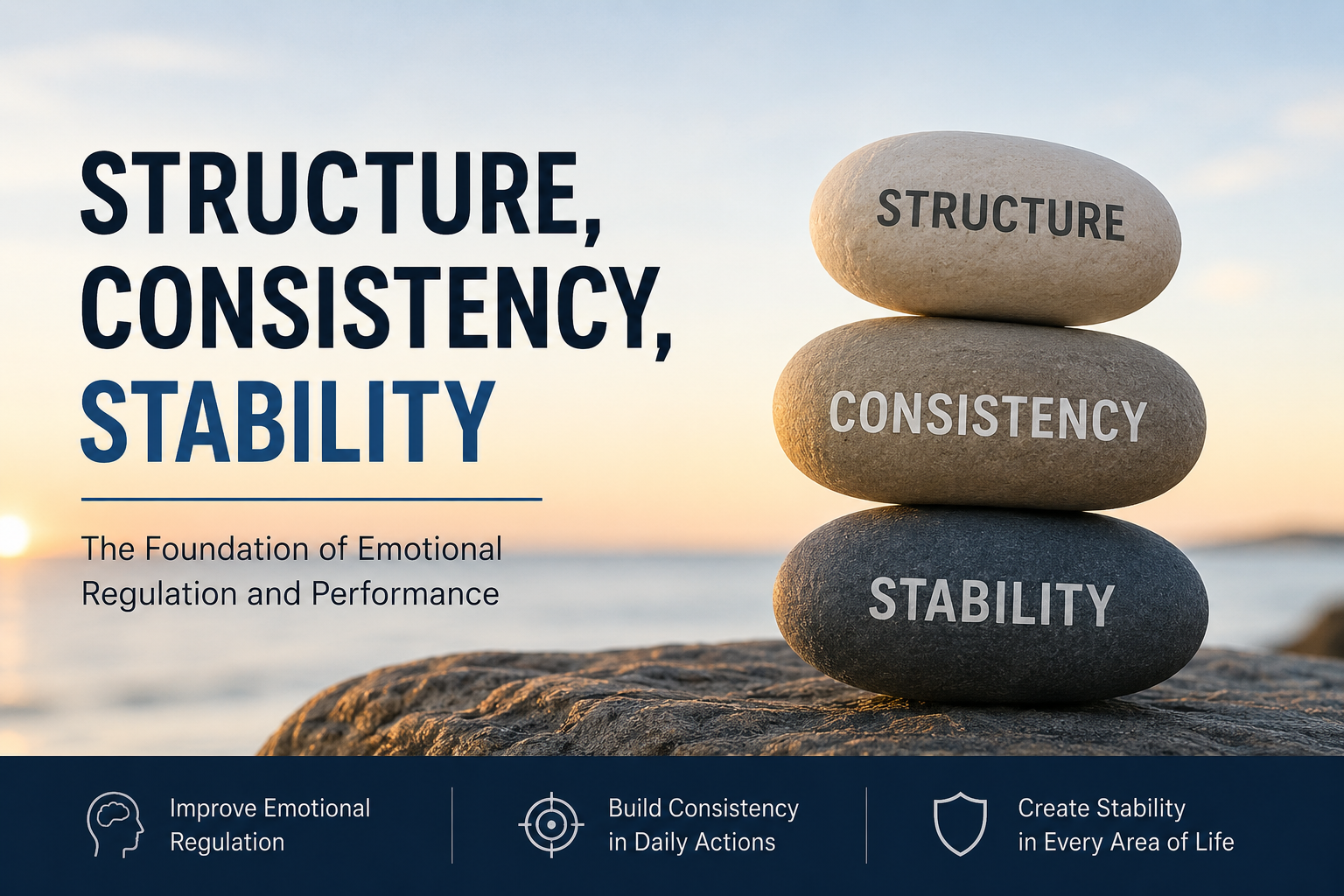
In a world obsessed with motivation, productivity, and performance, many people are overlooking the very thing that determines whether long-term growth is sustainable:
Stability.
Without stability, consistency becomes difficult.
Without consistency, structure collapses.
And without structure, performance becomes unpredictable.
This pattern appears everywhere.
It appears in workplaces struggling with burnout and turnover.
It appears in relationships overwhelmed by emotional reactivity.
It appears in individuals who want to change their lives but repeatedly fall back into destructive habits despite their best intentions.
The problem is often not intelligence, talent, or desire.
The problem is nervous system instability.
Why Stability Matters
Human beings perform best when the nervous system feels safe enough to remain present, focused, and adaptable under pressure.
When the nervous system becomes chronically dysregulated, survival mechanisms begin taking control. People become reactive instead of intentional. Small stressors feel overwhelming. Emotional responses intensify. Focus deteriorates. Recovery slows.
Over time, this creates inconsistency in behavior, communication, and decision-making. This is exactly the mechanism behind what causes inconsistent agent performance day to day — the same person, same training, same scripts, producing very different results depending on their regulation state on any given day.
This is why stability is not weakness.
Stability is strength.
A stable nervous system creates the foundation necessary for emotional regulation, critical thinking, discipline, and healthy relationships.
Structure Creates Predictability
Structure helps reduce unnecessary chaos.
Consistent routines, expectations, sleep patterns, communication habits, recovery practices, and environments create predictability for the nervous system. Predictability lowers stress load and increases emotional accessibility.
This is one reason highly successful individuals often rely on structure.
Structure is not about rigidity.
It is about reducing internal friction.
When people remove unnecessary instability from their lives, they conserve energy for growth, leadership, creativity, and problem-solving.
Without structure, many people spend their lives emotionally reacting to preventable stressors.
Consistency Builds Trust
Consistency is one of the most misunderstood aspects of personal growth.
Many people believe consistency means perfection.
It does not.
Consistency means repeatedly returning to alignment even after setbacks, stress, discomfort, or emotional activation.
Real consistency is recovery.
It is the ability to stabilize yourself and continue moving forward without abandoning the process every time life becomes difficult.
This applies to:
- Emotional regulation
- Leadership
- Parenting
- Relationships
- Business performance
- Physical health
- Mental health
- Personal development
The people who create lasting transformation are rarely the people who never struggle.
They are usually the people who continue returning to structure despite struggle.
Emotional Regulation and Stability
One of the greatest misconceptions about emotional intelligence is the belief that awareness alone creates change.
Awareness without regulation often increases suffering.
A person can become deeply aware of their patterns while still lacking the nervous system stability necessary to interrupt those patterns under pressure. This is the same gap that explains why scripts fail when regulation fails — knowing exactly what to say or do under pressure is never the same as being able to access it in the moment you actually need it.
This is why emotional regulation matters.
Regulation allows the brain and body to recover from activation more effectively. It increases access to reasoning, communication, emotional control, and intentional decision-making.
When regulation improves:
- Recovery speed improves
- Communication improves
- Decision-making improves
- Performance stabilizes
- Emotional reactivity decreases
- Behavioral consistency increases
Over time, this creates a stronger internal foundation.
The Hidden Link Between Stability and Performance
Many organizations focus heavily on outcomes while ignoring the nervous systems producing those outcomes.
Companies track:
- Productivity
- Turnover
- Escalations
- Attendance
- Customer satisfaction
- Performance metrics
But few stop to ask:
What internal conditions are driving behavioral inconsistency?
A dysregulated workforce often produces:
- Higher emotional escalation
- Increased burnout
- Poor communication
- Reduced adaptability
- Performance variability
- Increased conflict
Meanwhile, stable teams recover faster under stress and maintain performance more consistently during pressure.
The same principle applies to individuals.
Performance is rarely sustained through pressure alone.
Long-term performance is built through regulation, structure, consistency, and stability. The actual measurement problem behind that performance variability — and why averages hide it — is something we go deeper on in how to measure performance variability instead of just averages.
Final Thoughts
The goal is not perfection.
The goal is stability strong enough to continue growing under pressure.
Structure creates predictability.
Consistency reinforces trust.
Stability strengthens performance.
Over time, these principles reshape identity itself.
This is why emotional regulation is not simply about feeling better.
It is about becoming more accessible to growth, discipline, leadership, connection, and long-term transformation.
Because when the nervous system stabilizes, people begin making choices from clarity instead of survival.
To further explore the connection between emotional regulation, awareness, and long-term performance, the American Psychological Association provides valuable insight into emotional processes and behavioral health at https://www.apa.org/topics/emotions. You can also explore your own emotional regulation baseline through the Regulation Baseline Assessment available at https://nals.io/, designed to help individuals better understand recovery speed, stress response patterns, and behavioral consistency under pressure.
Leave a Reply