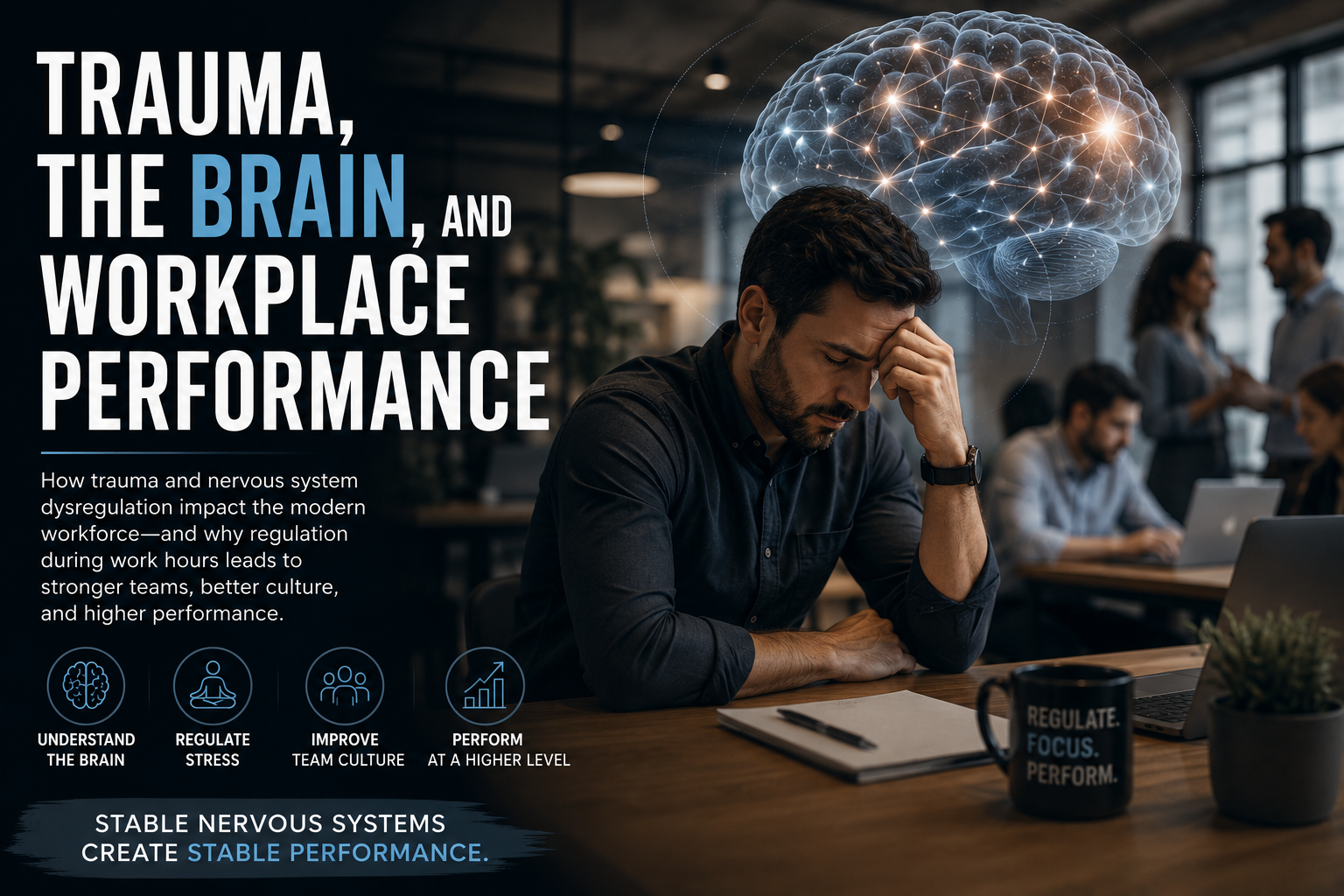
Why Emotional Regulation May Be One of the Most Overlooked Variables in Modern Work Culture
By Matthew F. Stevens
For years, workplaces have focused heavily on outcomes.
Metrics.
Productivity.
Attendance.
Customer satisfaction.
Performance scores.
Revenue.
But far fewer organizations stop to ask a deeper question:
What condition is the nervous system in that is producing these outcomes?
The truth is many workplaces are filled with intelligent, capable people operating from chronic stress states without even realizing it. What appears externally as laziness, disengagement, poor attitude, inconsistency, emotional reactivity, burnout, or lack of motivation is often something far deeper:
An overloaded nervous system is struggling to regulate itself under pressure.
Understanding trauma and nervous system regulation changed the way I viewed workplace culture forever.
Because trauma does not only affect emotions.
It affects the brain itself.
And those changes directly influence how people communicate, perform, recover, solve problems, connect with coworkers, and respond under pressure.
Trauma Is Far More Common Than Most People Realize
Research has consistently shown that nearly 70% of adults will experience at least one traumatic event during their lifetime.
And many experts believe younger generations are experiencing even higher levels of chronic stress exposure, instability, anxiety, social isolation, emotional overwhelm, and nervous system dysregulation than previous generations. Teenagers who lived during COVID are now a part of the workforce.
Now consider this reality:
These generations make up today’s workforce.
The workplace is no longer simply managing skill sets and productivity.
Organizations are managing human nervous systems operating under unprecedented levels of stress.
People are showing up to work carrying:
- childhood trauma
- emotional neglect
- financial pressure
- relationship instability
- chronic anxiety
- burnout
- overstimulation
- nervous system exhaustion
And most companies are still trying to solve these issues solely through pressure, coaching, accountability, or performance metrics.
But nervous systems do not respond to pressure indefinitely.
Eventually, they begin breaking down.
How Trauma Impacts the Brain
One of the biggest misconceptions about trauma is that people think it only affects memories or emotions.
In reality, chronic stress and trauma can impact multiple areas of the brain responsible for decision-making, emotional control, threat detection, focus, motivation, and recovery.
The Amygdala — The Threat Detection System
The amygdala is heavily involved in detecting danger and emotional significance.
When people experience chronic trauma or prolonged stress, the amygdala can become hyperactive.
This means the nervous system begins scanning constantly for:
- rejection
- criticism
- conflict
- embarrassment
- failure
- disrespect
- danger
In workplaces, this can look like:
- emotional overreactions
- defensiveness
- conflict escalation
- difficulty handling feedback
- chronic anxiety
- interpersonal tension
Many employees are not consciously trying to be difficult.
Their nervous systems are simply operating as though threat is always nearby. This is the same amygdala-driven pattern behind why escalations spike with certain agents but not others — threshold for what registers as threatening varies person to person, shaped by history rather than character.
The Prefrontal Cortex — Decision-Making and Emotional Control
The prefrontal cortex helps with:
- focus
- planning
- emotional regulation
- impulse control
- communication
- decision-making
But under chronic stress, this area becomes less accessible.
This is why highly intelligent people can suddenly:
- shut down under pressure
- become emotionally reactive
- struggle to focus
- make impulsive decisions
- overthink simple situations
- lose confidence quickly
In survival states, the brain prioritizes protection over clarity.
That impacts workplace performance dramatically. It’s the same mechanism behind why scripts fail when regulation fails — knowing the right words and being able to access them under pressure are two entirely different capacities.
The Hippocampus — Memory and Learning
The hippocampus plays a major role in memory and learning.
Chronic stress can impair how information is processed and stored.
This often contributes to:
- brain fog
- forgetfulness
- inconsistent performance
- trouble retaining training
- mental exhaustion
Many employees silently blame themselves for these struggles without realizing their nervous systems may still be recovering from years of stress exposure. That inconsistency isn’t random, either — we go deeper on what actually causes day-to-day performance inconsistency here.
The Workforce Is Filled with Nervous Systems, Not Just Employees
One thing I began noticing over time was this:
People do not leave their nervous systems at home when they clock into work.
They bring:
- fear
- insecurity
- stress
- trauma
- survival adaptations
- relationship pain
- emotional exhaustion
into every interaction.
The modern workplace often treats performance as though human beings are machines.
But human beings are biological systems first.
And dysregulated systems create inconsistent outcomes.
Healing Through Structure, Movement, and Connection
Some of the greatest growth I experienced did not come from a textbook.
It came through a simple human connection with coworkers like Drew and Brandon.
Trips to the gym became more than workouts.
They became a regulation.
Movement.
Connection.
Structure.
Consistency.
Accountability.
Stress release.
Without fully realizing it at first, we were creating moments of nervous system recovery inside the middle of stressful work environments.
The gym gave us:
- emotional decompression
- camaraderie
- discipline
- emotional processing
- confidence
- healthy stress release
And over time, those moments created real emotional growth.
This is one of the biggest things modern workplaces often overlook:
Regulated connection changes people.
Not pressure.
Not shame.
Not endless motivation.
Connection.
Consistency.
Recovery.
Leadership and Psychological Safety Matter
One moment that stood out to me deeply was when Eric, the Vice President of our company, invited several of us into a sit-down discussion about workplace culture.
What mattered was not just the meeting itself.
It was what the meeting represented.
People felt heard.
Leadership listened.
Questions were asked.
Experiences were acknowledged.
That matters more than many organizations realize.
Because workplace culture is not built only through policies.
It is built through nervous system experiences.
Employees remember:
- whether leadership listens
- how managers respond under stress
- whether communication feels safe
- whether they feel disposable or valued
- whether pressure is balanced with support
Leadership directly impacts regulation inside organizations.
And regulated teams communicate differently. This is exactly why good individual contributors so often become bad supervisors once promoted — the role demands a kind of self-awareness and regulation capacity that technical skill alone never required.
Why ORS™ Was Created
One of the biggest realizations of my life was understanding this:
Stable nervous systems create more stable performance.
That realization eventually led me to begin developing ORS™ (Operational Regulation Systems).
ORS™ was built around a simple but powerful concept:
If chronic stress and nervous system dysregulation are impacting workplace performance, then regulation itself must become part of the operational environment.
Not as therapy.
Not as motivation.
But as a structured nervous system conditioning integrated into the workday itself.
The purpose is simple:
- help employees recover faster
- reduce emotional escalation
- improve consistency
- improve focus
- reduce nervous system overload
- stabilize performance under pressure
Testing Regulation in Real Time
Over time, I began informally testing regulation concepts with coworkers inside real workplace environments.
Not through lectures.
Not through theory alone.
But through practical nervous system regulation tools, structured recovery moments, mindset shifts, movement, breathing, awareness, and behavioral consistency.
What I repeatedly observed was this:
When people became more regulated:
- communication improved
- emotional reactions lowered
- confidence stabilized
- focus improved
- stress recovery became faster
- workplace interactions became healthier
People often did not need more pressure.
They needed nervous system recovery.
Final Thoughts
The future of workplace performance may depend far more on nervous system regulation than most organizations currently realize.
Trauma and chronic stress do not stay outside workplace walls.
They quietly influence:
- communication
- teamwork
- leadership
- morale
- productivity
- burnout
- emotional control
- consistency
And as younger generations carrying unprecedented levels of stress continue entering the workforce, organizations that ignore nervous system regulation may increasingly struggle with instability, burnout, turnover, and emotional exhaustion.
But when workplaces begin prioritizing:
- regulation
- structure
- recovery
- connection
- psychological safety
- healthy leadership
something powerful happens.
People stop functioning from survival.
And begin functioning from stability.
About the Author
Matthew F. Stevens is the creator of ORS™ (Operational Regulation Systems), founder of NALS™ (Neuro Advanced Learning Systems), and host of the EQ Unlocked podcast focused on emotional regulation, nervous system stability, and workplace performance under pressure.
Additional research on how chronic stress impacts the brain and body can be found through the American Psychological Association.
Listen to EQ Unlocked:
https://eq.matthewfstevens.com
Take the Regulation Baseline Assessment:
https://nals.io/
Leave a Reply