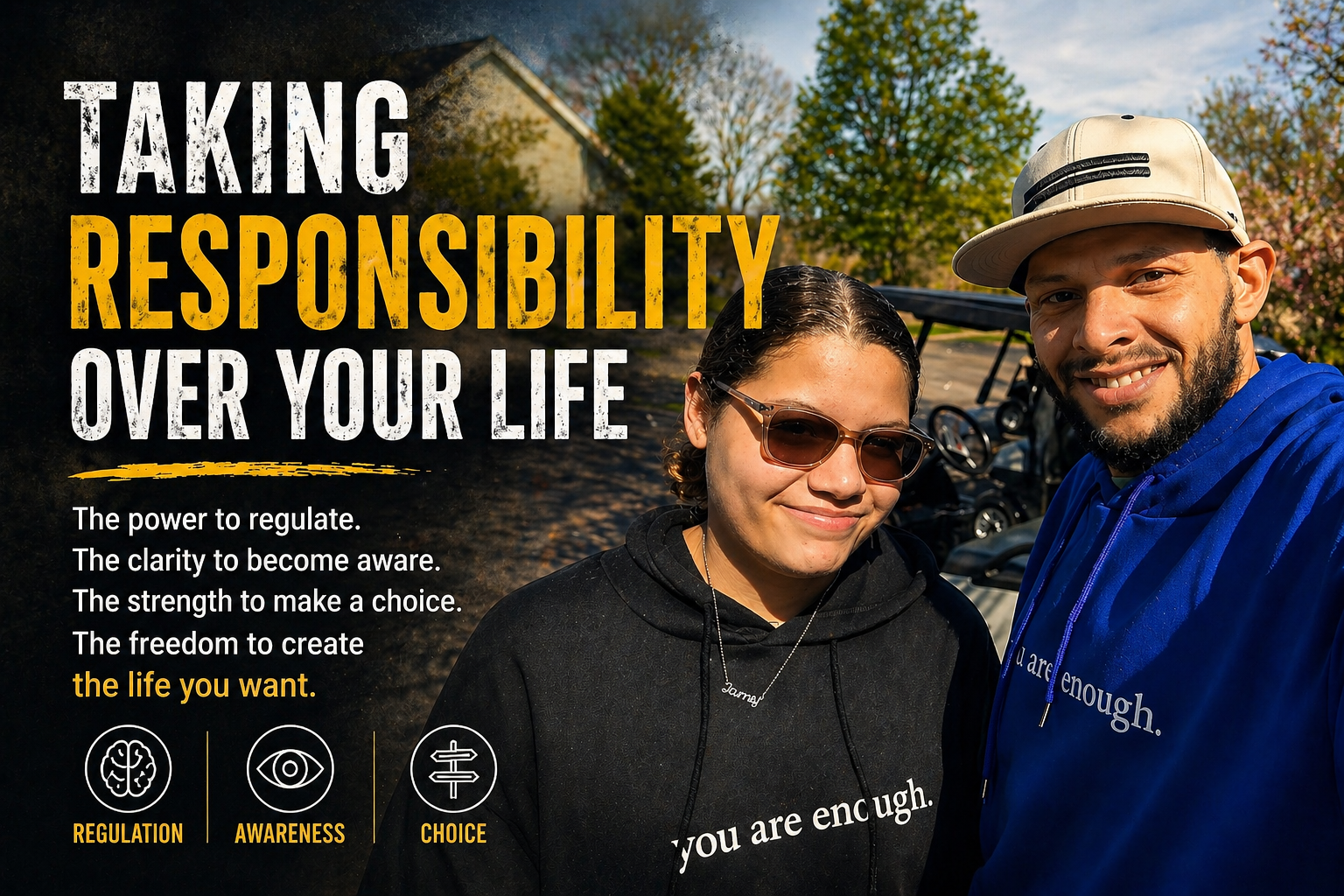
Most people believe taking responsibility for your life means working harder, thinking differently, or holding yourself accountable.
But if that were true, change would be easy.
You would decide once—and follow through.
That’s not what happens.
You start strong. You have clarity. You know what needs to change.
And then something shifts.
You fall back into the same patterns, the same reactions, and the same outcomes.
That’s not a character flaw.
That’s a regulation problem.
Why I Walked Into a Call Center
When I started working at a call center, my goal wasn’t to build ORS™ (Operational Regulation Systems). My goal was to do what I had never done — to become the man I needed to become, and I already knew that meant getting uncomfortable.
I took a job below my earning potential. My boss was younger than my oldest child. For the first time in longer than I could remember, I walked into an environment I knew almost nothing about. I had to rebuild my foundation, starting closer to the ground than I had in years.
I left things behind that mattered to me — relationships, a version of my life I’d built, comfort I’d grown used to — because I’d come to understand that becoming who I wanted to become required taking on real responsibility, not the comfortable kind. ORS wasn’t the plan. ORS was a consequence of doing that internal work first.
If you want to hear more of this story directly, I went deeper on it in a recent conversation on Vigilantes Radio Live.
Why Taking Responsibility Feels So Difficult
Taking responsibility requires one thing most people don’t have:
👉 The ability to stay regulated under pressure
Because responsibility isn’t just about what you know—it’s about what you can do in the moment.
When your nervous system is dysregulated:
- Your thinking becomes reactive
- Your emotions become amplified
- Your decisions become inconsistent
You don’t act based on your values.
You act based on your state. This is the exact same mechanism behind why scripts fail when regulation fails — knowing exactly what you should say or do is never the same as being able to access it once your state has shifted.
A Personal Example: What Responsibility Used to Look Like
Before I understood how my nervous system was shaping my behavior, I approached responsibility the way most people do—through effort, pressure, and trying to force change.
This video reflects that version of me. The message still holds value, but it’s incomplete.
What I understand now is this:
Responsibility isn’t just a decision—it’s a capacity.
If your nervous system isn’t regulated, even the strongest intentions won’t hold when pressure shows up.
The Truth Most People Avoid
You don’t avoid responsibility because you don’t care.
You avoid responsibility because:
👉 Responsibility requires discomfort—and your system is trained to escape it
That escape shows up as:
- Procrastination
- Blame
- Justification
- Distraction
Not because you’re weak…
But because your body is trying to return to what feels familiar.
Why You Keep Repeating the Same Patterns
You’ve probably said this before:
“I know what to do… I just didn’t do it.”
That’s the gap between:
- Awareness
- Action
And that gap is filled by your nervous system.
If you’re not regulated:
- You can’t pause
- You can’t choose
- You can’t follow through
This same gap is what’s actually behind inconsistent performance day to day — the same person, the same knowledge, the same intentions, producing very different results depending on regulation state.
Responsibility Isn’t Mental—It’s Physiological
This is where everything shifts.
Taking responsibility is not:
- Forcing yourself
- Thinking positively
- Trying harder
It’s:
👉 Building the capacity to stay present and act under pressure
Because when you’re regulated:
- You slow down
- You think clearly
- You respond intentionally
That’s where responsibility lives.
How to Start Taking Responsibility for Your Life
Not all at once. Not perfectly.
Start here:
1. Regulate Before You React
Before making a decision, ask:
“Am I regulated right now?”
If not, pause.
2. Shrink the Moment
Don’t try to fix your life.
Focus on:
👉 The next decision
Responsibility is built in small, repeatable actions.
3. Stop Escaping Discomfort
Notice when you:
- Avoid
- Distract
- Delay
That’s your nervous system trying to leave the moment.
Stay instead.
4. Focus on Recovery, Not Perfection
You will react.
The difference is:
👉 How quickly you return to baseline
That’s where growth happens. The capacity to recover quickly isn’t fixed, either — it’s shaped by what you’ve actually lived through, the same way stress threshold itself turns out to be built rather than innate, not a trait some people simply have and others don’t.
The Shift That Changes Everything
You don’t take responsibility by becoming a different person.
You take responsibility by becoming someone who can:
👉 Stay in the moment long enough to choose differently
Final Thought
Taking responsibility for your life isn’t about control.
It’s about capacity.
The capacity to:
- Stay present
- Stay regulated
- Stay aligned with your values
Because when you can stay…
You can finally follow through. Here is a great read I found on the connection between happiness and responsibility: Journal of Happiness Studies | Springer Nature Link.
If you want to understand where your current baseline is and why you struggle to follow through:
👉 Take the Regulation Baseline Assessment:
https://nals.io/


Leave a Reply