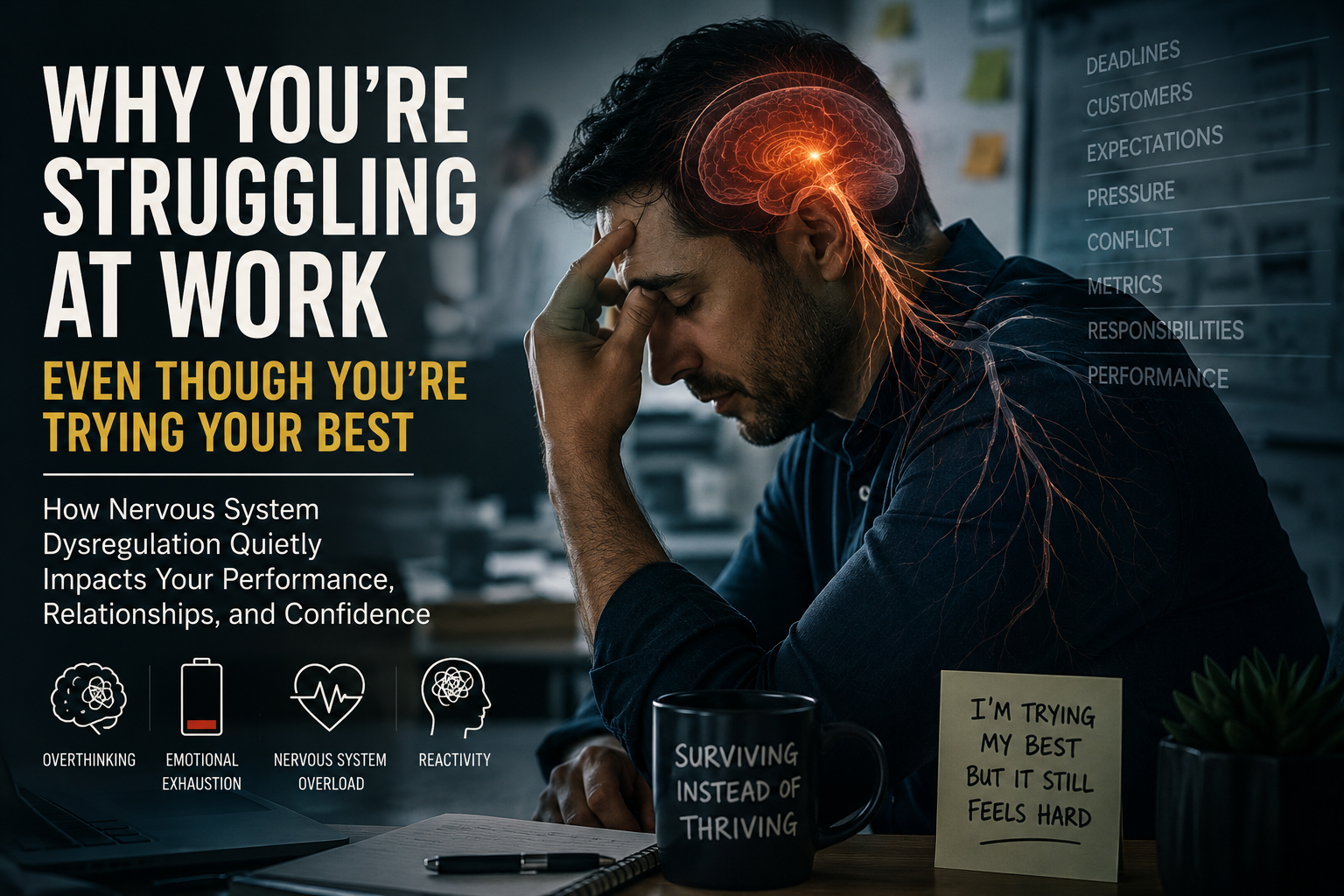
How Nervous System Dysregulation Quietly Impacts Your Performance, Relationships, and Confidence
For years, I believed struggling at work was mostly about discipline. I thought if people simply worked harder, stayed focused, or cared more, they would naturally improve.
Then life humbled me.
I worked in factories. Medical facilities. High-pressure environments. Places where numbers mattered, emotions were ignored, and stress slowly became the new normal.
And I began noticing something that changed the way I viewed people forever: many employees who are struggling at work are not failing because they are lazy. They are struggling because their nervous systems are overloaded — and most of them have no idea it is happening.
Struggling at Work Is Often a Nervous System Problem
When most people think about struggling at work, they think about motivation, skill gaps, or attitude. What they rarely consider is the physiological state of the person showing up every day.
According to the American Psychological Association, chronic stress directly impacts memory, decision-making, emotional control, and physical health — the exact capacities a dysregulated nervous system undermines every single workday.
This is the conversation most workplaces are not having. And it is costing people — and organizations — more than anyone is measuring.
What Dysregulation Actually Is
Dysregulation is not stress. Stress is normal, temporary, and in managed doses, productive.
Dysregulation is what happens when stress has no recovery path. When the nervous system is activated repeatedly — by workload, conflict, uncertainty, or environment — without a structured opportunity to return to baseline, it stops treating stress as temporary. It begins by treating it as a permanent condition.
In that state, the prefrontal cortex — responsible for rational decision-making, impulse control, and clear communication — begins operating at reduced capacity. The amygdala, the brain’s threat-detection system, takes over.
The result is an employee who is physically present and cognitively compromised. Not because they don’t care. Because their nervous system has been running in emergency mode for so long that emergency mode has become their operating system.
Research from Dr. Bruce Perry confirms that early experiences don’t just form memories — they form the neural architecture through which every future experience gets interpreted. That architecture shapes how people respond to pressure, conflict, and stress at work long before they ever clock in.
How Chronic Stress Shows Up at Work
If you are struggling at work despite your best effort, chronic stress may be the reason your performance feels inconsistent. You may notice:
- Mental exhaustion that arrives faster than it should
- Small problems that feel enormous
- Criticism that lands as a personal attack
- Difficulty recovering after stressful calls or interactions
- Overthinking conversations long after they happen
- Emotional reactivity under pressure
- Confidence that fluctuates without warning
- Dread before the workday even begins
This is not weakness. This is what survival physiology feels like when it becomes chronic. The difficulty recovering after one hard interaction before the next one starts isn’t random, either — we go deeper on why the same person performs differently call to call here.
My Own Experience Changed Everything
There was a period in my life where I believed I was simply bad at being an employee.
I had spent years helping children and families through intense trauma work. Then life forced me into entirely different environments — factories, corporate structures, call centers.
At first, I hated it. But eventually I realized something important: the workplace itself was showing me human nervous systems in real time.
I watched highly intelligent people completely lose emotional control over small stressors. I watched managers shut down under pressure. I watched employees carry trauma into customer interactions without realizing it.
And I recognized something uncomfortable: I was doing it too.
There were moments where my body was at work but my nervous system was somewhere else entirely — still carrying stress, still operating in survival mode, still preparing for danger that no longer existed.
That realization changed the direction of my life.
Why Awareness Alone Is Not Enough
One of the hardest truths I had to learn was this: awareness without regulation can become torture.
You may fully understand your patterns and still feel unable to stop them. You know you are overreacting. You know you are spiraling. You know you are exhausted. But your nervous system is already activated — and understanding why does not change the physiology.
This is why the framework I teach begins with Regulation — not Awareness.
Regulation → Awareness → Choice
Not awareness first. Because when the nervous system becomes more regulated, thinking becomes clearer, recovery becomes faster, emotions become easier to process, and self-awareness becomes something that helps rather than haunts.
Without regulation, awareness often turns into rumination. And rumination is not healing — it is suffering with extra steps. This is the same reason knowing a script perfectly doesn’t help if regulation isn’t there to access it — we cover this exact mechanism in detail here.
Most People Who Are Struggling at Work Were Never Taught Regulation
Most people who are struggling at work have never been taught that their nervous system — not their character — is what needs attention.
They learned survival. Not regulation.
So when pressure rises, the nervous system falls back on old patterns: defensiveness, avoidance, people pleasing, anger, withdrawal, shutdown, overworking, perfectionism, hypervigilance.
And many employees silently blame themselves for reactions they do not yet understand.
The nervous system does not care about your job title. Trauma and chronic stress do not disappear because you clock in. People carry entire histories into workplaces — loss, abandonment, fear, shame, financial stress, relationship pain, emotional neglect. Most never learned tools for processing any of it. This is also why the same person can perform brilliantly one day and struggle the next — we go deeper on what actually causes that day-to-day inconsistency here.
What Regulation Actually Looks Like at Work
Regulation is not pretending to be calm. It is not suppressing emotions or forcing positivity.
Real regulation looks like recovering faster after stress, breathing intentionally during activation, catching yourself before escalation, returning to baseline quicker, and remaining present during pressure without being consumed by it.
This changes work performance dramatically over time. Because stable nervous systems create stable behavior. And stable behavior creates consistent results.
You Are Not Broken
Many people secretly believe they are failing at life because they struggle under pressure. But what they are often experiencing is a nervous system that adapted to survive difficult environments — and survival patterns that once protected them are now interfering with their growth.
The good news is this: nervous systems can change. Recovery speed can improve. Emotional regulation can be strengthened. And performance often improves naturally once the nervous system begins stabilizing. Struggling at work doesn’t have to be permanent.
The Work Is Not About Trying Harder
The modern workplace is filled with people struggling at work and silently operating in survival mode. People who are intelligent, capable, hardworking, and talented — but overwhelmed internally.
Understanding nervous system regulation changed the way I viewed performance forever. Because behind many struggles at work is not a lack of effort. It is an overloaded nervous system trying to survive another day.
And once people begin learning how to regulate, recover faster, and return to baseline under pressure, something powerful happens. Emotional intelligence strengthens. Performance stabilizes. They stop merely surviving work and begin functioning from a place of clarity and choice.
That transformation is what I built NALS — Neuro Advanced Learning Systems to deliver.
NALS is not a motivational program. It is a structured, evidence-based system built around the RAC framework — Regulation, Awareness, Choice — that gives you the practical tools to change how your nervous system responds to pressure, conflict, and stress. Not through willpower. Through rewiring.
If you are ready to stop white-knuckling your way through the workday and start building something that actually holds — explore NALS here.
And if you want to understand the deeper story behind this work — how I went from a man whose nervous system treated everyone as a threat to someone who built a career helping others regulate theirs — that story is told in full in my book Everyone Is a Suspect.
Regulation. Awareness. Choice. In that order. Always in that order.
Matthew F. Stevens is the founder of ORS™ (Operational Regulation Systems) and NALS™ (Neuro Advanced Learning Systems), and the host of EQ Unlocked. His work sits at the intersection of neuroscience, emotional intelligence, and operational performance. Everyone Is a Suspect is his first book.
Leave a Reply