Tag: emotional intelligence

  • Why Your Call Center’s Turnover Problem Is Actually a Nervous System Problem

    Why Your Call Center’s Turnover Problem Is Actually a Nervous System Problem

    Call centers lose between 30 and 45 percent of their workforce every year.

    Most leadership teams treat that number as a hiring problem, a compensation problem, or a management problem.

    It isn’t any of those things.

    It is a nervous system problem. And until you treat it as one, the number will not change — regardless of how much you spend on recruiting, onboarding, or incentive programs.


    The Real Cost of Dysregulation in a Call Center

    When a call center agent is dysregulated — chronically stressed, emotionally flooded, or operating in a sustained state of threat response — several things happen simultaneously.

    Their prefrontal cortex, which governs impulse control, decision-making, and clear communication, goes partially offline. Their escalation rate increases. Their first-call resolution rate drops. Their after-call work time extends. And eventually, they leave — not because the job is too hard, but because the environment has given them no tools to manage what the job does to their nervous system.

    The replacement cost for one call center agent runs between $10,000 and $15,000 when recruitment, onboarding, and lost productivity are factored in. In a center with 200 agents and 40 percent annual turnover, that is $800,000 to $1.2 million spent annually — not on growth, not on technology, not on market expansion — on replacing people who should never have left.

    That number does not show up on a report labeled “dysregulation.”

    It shows up labeled “turnover,” “absenteeism,” “performance variance,” and “escalation costs.”

    But the root cause is the same in each case.

    What Dysregulation Actually Is

    Dysregulation is not stress. Everyone experiences stress.

    Dysregulation is what happens when stress has no recovery path — when the nervous system is activated repeatedly without the opportunity to return to baseline. In that state, the body and brain operate as if under constant threat. Decision-making narrows. Emotional reactivity increases. Performance becomes inconsistent. And over time, the person begins to withdraw — psychologically first, then physically.

    In a call center, this is not a rare condition. It is the default state for a significant portion of your workforce on any given day.


    Why Call Centers Manufacture Dysregulation

    A call center environment is physiologically demanding in ways that most operational frameworks do not account for.

    Agents absorb emotional labor on every call. They express emotions they do not feel, suppress emotions they do, and are evaluated on how well they manage that gap. Research consistently links this emotional dissonance — the distance between expressed and felt emotion — to exhaustion, disengagement, and increased intention to leave.

    Beyond the calls themselves, agents operate in:

    • High-noise, high-volume environments that keep the nervous system on alert
    • Compressed schedules with limited autonomy over pacing and recovery
    • Continuous performance monitoring that maintains a low-grade threat state
    • Back-to-back call queues with no structured recovery between difficult interactions
    • Inconsistent supervision that adds unpredictability to an already demanding environment

    Each of these factors independently activates the stress response. Together, they create a sustained sympathetic nervous system state that, without a recovery system, becomes the new baseline.

    The body does not distinguish between an angry customer and a physical threat. It responds the same way: elevated cortisol, narrowed cognitive function, and an accelerating drive toward escape.

    When the escape is not available in the moment — because they need the job — agents regulate through the only methods available: disengagement, absenteeism, and eventually resignation.

    This is not a character problem. It is a systems problem.

    The Financial Fingerprint of a Dysregulated Workforce

    Before an agent resigns, dysregulation leaves a measurable trail:

    Rising escalation rates — an agent who cannot regulate their own nervous system cannot de-escalate a customer’s.

    Declining first-call resolution — dysregulation narrows problem-solving. The brain in a stress state reaches for the fastest available exit, not the most effective solution.

    Increasing after-call work time — emotional recovery takes time the workflow does not build in, so it bleeds into post-call documentation.

    Widening performance variance — a dysregulated agent performs well on their best days and poorly on their worst, with no predictable middle. That inconsistency is expensive to manage and impossible to scale.

    Absenteeism patterns — the nervous system, given no structured recovery, takes recovery by force. Sick days spike. Call-outs increase. Attendance incentives become a cost center.

    Each of these is a measurable business metric. Each of them is downstream of the same unaddressed root cause.


    The Supervisor Problem Nobody Talks About

    Dysregulation does not stay at the agent level. It travels through teams.

    A dysregulated supervisor dysregulates every person beneath them.

    When a team lead operates from a chronic stress state — reactive, emotionally inconsistent, unpredictable in their responses — their team mirrors that state. Write-up rates increase. Team morale drops. Performance variance widens across the unit, not just in individual agents.

    Most supervisors in call centers were promoted because they were exceptional agents. They were not trained to:

    • Identify dysregulation in a team member before it becomes a conduct issue
    • Regulate themselves before entering a difficult conversation
    • Use language that de-escalates rather than triggers defensive responses
    • Recognize when their own state is affecting their team’s performance

    That gap — between what they are expected to do and what they were prepared for — is where dysregulation spreads from individual agents into entire teams. And from teams into floor-wide performance metrics.

    This is the invisible multiplier in your turnover equation. A dysregulated supervisor does not just struggle themselves. They amplify the dysregulation of everyone around them.


    What a Nervous System Solution Looks Like

    Most approaches to call center performance address symptoms. Incentive programs reward attendance without addressing why people aren’t attending. Training programs improve scripts without addressing why agents can’t access those scripts under pressure. Wellness offerings provide gym memberships while the environment that requires the gym remains unchanged.

    ORS — Operational Regulation Systems — addresses the root.

    Built specifically for high-volume, high-stress operational environments, ORS works at three distinct levels — because the problem exists at three levels.

    Level 1 — The Agent

    ORS installs regulation checkpoints into the existing workflow without disrupting handle time or operational flow.

    Pre-shift protocol (4 minutes): A structured nervous system preparation practice before the first call. This is not meditation. It is a physiological priming sequence that moves the agent from whatever state they arrived in to a regulated baseline before they touch a headset.

    In-call micro-regulation: Techniques agents use in real time — during holds, between call phases, in moments of customer escalation — that interrupt the stress response before it affects performance. These are designed to be invisible to the customer and compatible with call monitoring.

    Post-call recovery protocol: A structured 60-to-90-second reset between calls that prevents emotional carryover. This is the single most underutilized intervention available in call center operations. The industry knows that hard calls affect subsequent performance. ORS builds the recovery system that breaks that chain.

    Metrics this moves: Escalation rate. First-call resolution. After-call work time. Agent consistency score. Attendance patterns.

    Level 2 — The Supervisor

    ORS provides supervisors with the specific capabilities their promotion did not include.

    Dysregulation identification: How to recognize when a team member is approaching a dysregulation threshold before it manifests as a performance or conduct issue — and what to do at that point.

    Self-regulation first: How to assess and regulate their own state before any difficult conversation, performance review, or team interaction. A supervisor who enters a correction conversation dysregulated will dysregulate the person they are correcting. ORS breaks this pattern.

    De-escalation language: Specific communication frameworks that address behavior without triggering defensive responses — the difference between a conversation that produces behavior change and one that produces a grievance.

    Metrics this moves: Team performance variance. Write-up volume. Team-level retention. Supervisor confidence and consistency scores.

    Level 3 — The Operation

    This is where most programs stop short.

    ORS audits the operational decisions that manufacture dysregulation in the first place.

    Scheduling design. Break structure and placement. Call queue management. Performance review language. Escalation protocols. Attendance policy framing.

    Each of these operational decisions either increases or decreases the nervous system load of your workforce. Most were designed without that consideration. ORS identifies which decisions are costing you the most in regulation terms — and provides specific, implementable modifications.

    This is not a culture initiative. It is an operational audit with specific deliverables. The goal is not to make the workplace feel better. It is to make it function better by removing the systemic conditions that make regulation impossible.

    Metrics this moves: Systemic stress load. Workforce retention rate. Cost-per-agent over a 90-day measurement period.


    The Business Case for a Pilot

    The question is not whether your call center has a regulation problem. At scale, every call center does.

    The question is what that problem is currently costing you — and what it would cost to address it with precision.

    A 60-day ORS pilot on one team provides a clean, controlled answer.

    The pilot team’s performance is measured against its own baseline and against a comparable non-pilot team. At 30 days, a mid-point review identifies what is moving and what needs adjustment. At 60 days, a full results report provides specific data on which metrics moved, by how much, and what the ROI looks like before any decision is made about broader implementation.

    At the end of 60 days, you have one of two things: data that justifies scaling — or data that tells you what to refine.

    Either way, you have something most organizations never develop for this problem: a measurable answer.

    The pilot investment is a fraction of one month’s cost of the problem it is designed to solve.

    That is not a budget conversation. That is an ROI conversation.


    About the Author

    Matthew F. Stevens is the founder of ORS (Operational Regulation Systems) and NALS (Neuro Advanced Learning Systems), and the host of EQ Unlocked. He is certified as a Trauma and Resilience Practitioner through Starr Commonwealth, certified in Neuro-Linguistic Programming, and has trained under Dr. Bruce Perry and Dr. Bessel van der Kolk. His work sits at the intersection of neuroscience, emotional intelligence, and operational performance — building systems that change how organizations function from the nervous system up.


    Frequently Asked Questions

    What is dysregulation in a workplace context?

    Dysregulation refers to a state in which the nervous system is operating in a sustained stress response rather than a regulated baseline. In a call center, this manifests as emotional reactivity, inconsistent performance, poor communication under pressure, and increased absenteeism and turnover intention. It is not a personality trait. It is a physiological state — and physiological states can be changed with the right system.

    How is ORS different from an employee wellness program?

    Wellness programs address symptoms. ORS addresses the operational conditions that produce the symptoms. A gym stipend does not change how an agent’s nervous system responds to their fourteenth difficult call of the day. ORS changes the workflow and environment so the nervous system has a structured recovery path built into the operational design — not offered as an optional benefit.

    How quickly can ORS show measurable results?

    A 60-day pilot typically shows movement in escalation rates and consistency scores within the first 30 days. Turnover impact is measured across the full pilot period against a baseline established at day one. Supervisor-level metrics often move faster than agent-level metrics because supervisors have more direct control over their own behavior.

    What industries beyond call centers does ORS serve?

    ORS is applicable to any high-volume, high-stress operational environment — healthcare, logistics, retail operations, financial services, and any organization where human performance is the primary operational variable. The nervous system principles are consistent across industries. The implementation is customized to the operational context.

    What does an ORS engagement begin with?

    Every ORS engagement begins with a 30-minute discovery conversation in which we examine your current performance data together and identify where dysregulation is the root cause of what you’re already measuring. No commitment is required at that stage. The conversation either confirms that ORS is the right fit — or tells us both that it isn’t. Either outcome is useful.

    How do I learn more about ORS?

    Use the contact form below or visit the ORS services page to schedule a discovery conversation.

    ORS — Operational Regulation Systems — addresses the root.

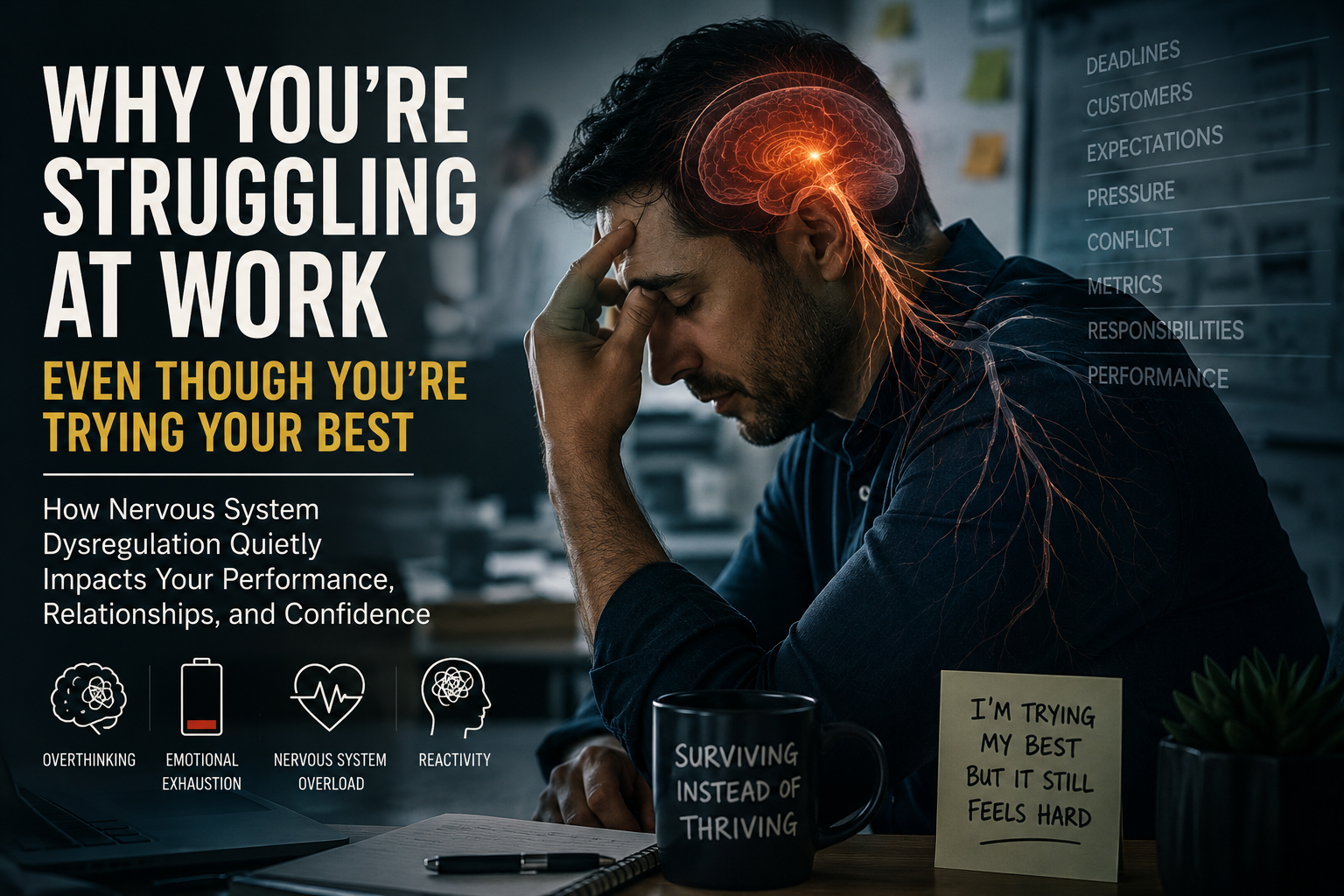
  • Why You’re Struggling at Work Even Though You’re Trying Your Best

    Why You’re Struggling at Work Even Though You’re Trying Your Best

    How Nervous System Dysregulation Quietly Impacts Your Performance, Relationships, and Confidence

    For years, I believed struggling at work was mostly about discipline. I thought if people simply worked harder, stayed focused, or cared more, they would naturally improve.

    Then life humbled me.

    I worked in factories. Medical facilities. High-pressure environments. Places where numbers mattered, emotions were ignored, and stress slowly became the new normal.

    And I began noticing something that changed the way I viewed people forever: many employees who are struggling at work are not failing because they are lazy. They are struggling because their nervous systems are overloaded — and most of them have no idea it is happening.


    Struggling at Work Is Often a Nervous System Problem

    When most people think about struggling at work, they think about motivation, skill gaps, or attitude. What they rarely consider is the physiological state of the person showing up every day.

    According to the American Psychological Association, chronic stress directly impacts memory, decision-making, emotional control, and physical health — the exact capacities a dysregulated nervous system undermines every single workday.

    This is the conversation most workplaces are not having. And it is costing people — and organizations — more than anyone is measuring.


    What Dysregulation Actually Is

    Dysregulation is not stress. Stress is normal, temporary, and in managed doses, productive.

    Dysregulation is what happens when stress has no recovery path. When the nervous system is activated repeatedly — by workload, conflict, uncertainty, or environment — without a structured opportunity to return to baseline, it stops treating stress as temporary. It begins by treating it as a permanent condition.

    In that state, the prefrontal cortex — responsible for rational decision-making, impulse control, and clear communication — begins operating at reduced capacity. The amygdala, the brain’s threat-detection system, takes over.

    The result is an employee who is physically present and cognitively compromised. Not because they don’t care. Because their nervous system has been running in emergency mode for so long that emergency mode has become their operating system.

    Research from Dr. Bruce Perry confirms that early experiences don’t just form memories — they form the neural architecture through which every future experience gets interpreted. That architecture shapes how people respond to pressure, conflict, and stress at work long before they ever clock in.


    How Chronic Stress Shows Up at Work

    If you are struggling at work despite your best effort, chronic stress may be the reason your performance feels inconsistent. You may notice:

    • Mental exhaustion that arrives faster than it should
    • Small problems that feel enormous
    • Criticism that lands as a personal attack
    • Difficulty recovering after stressful calls or interactions
    • Overthinking conversations long after they happen
    • Emotional reactivity under pressure
    • Confidence that fluctuates without warning
    • Dread before the workday even begins

    This is not weakness. This is what survival physiology feels like when it becomes chronic.


    My Own Experience Changed Everything

    There was a period in my life where I believed I was simply bad at being an employee.

    I had spent years helping children and families through intense trauma work. Then life forced me into entirely different environments — factories, corporate structures, call centers.

    At first, I hated it. But eventually I realized something important: the workplace itself was showing me human nervous systems in real time.

    I watched highly intelligent people completely lose emotional control over small stressors. I watched managers shut down under pressure. I watched employees carry trauma into customer interactions without realizing it.

    And I recognized something uncomfortable: I was doing it too.

    There were moments where my body was at work but my nervous system was somewhere else entirely — still carrying stress, still operating in survival mode, still preparing for danger that no longer existed.

    That realization changed the direction of my life.


    Why Awareness Alone Is Not Enough

    One of the hardest truths I had to learn was this: awareness without regulation can become torture.

    You may fully understand your patterns and still feel unable to stop them. You know you are overreacting. You know you are spiraling. You know you are exhausted. But your nervous system is already activated — and understanding why does not change the physiology.

    This is why the framework I teach begins with Regulation — not Awareness.

    Regulation → Awareness → Choice

    Not awareness first. Because when the nervous system becomes more regulated, thinking becomes clearer, recovery becomes faster, emotions become easier to process, and self-awareness becomes something that helps rather than haunts.

    Without regulation, awareness often turns into rumination. And rumination is not healing — it is suffering with extra steps.


    Most People Who Are Struggling at Work Were Never Taught Regulation

    Most people who are struggling at work have never been taught that their nervous system — not their character — is what needs attention.

    They learned survival. Not regulation.

    So when pressure rises, the nervous system falls back on old patterns: defensiveness, avoidance, people pleasing, anger, withdrawal, shutdown, overworking, perfectionism, hypervigilance.

    And many employees silently blame themselves for reactions they do not yet understand.

    The nervous system does not care about your job title. Trauma and chronic stress do not disappear because you clock in. People carry entire histories into workplaces — loss, abandonment, fear, shame, financial stress, relationship pain, emotional neglect. Most never learned tools for processing any of it.


    What Regulation Actually Looks Like at Work

    Regulation is not pretending to be calm. It is not suppressing emotions or forcing positivity.

    Real regulation looks like recovering faster after stress, breathing intentionally during activation, catching yourself before escalation, returning to baseline quicker, and remaining present during pressure without being consumed by it.

    This changes work performance dramatically over time. Because stable nervous systems create stable behavior. And stable behavior creates consistent results.


    You Are Not Broken

    Many people secretly believe they are failing at life because they struggle under pressure. But what they are often experiencing is a nervous system that adapted to survive difficult environments — and survival patterns that once protected them are now interfering with their growth.

    The good news is this: nervous systems can change. Recovery speed can improve. Emotional regulation can be strengthened. And performance often improves naturally once the nervous system begins stabilizing. Struggling at work doesn’t have to be permanent.


    The Work Is Not About Trying Harder

    The modern workplace is filled with people struggling at work and silently operating in survival mode. People who are intelligent, capable, hardworking, and talented — but overwhelmed internally.

    Understanding nervous system regulation changed the way I viewed performance forever. Because behind many struggles at work is not a lack of effort. It is an overloaded nervous system trying to survive another day.

    And once people begin learning how to regulate, recover faster, and return to baseline under pressure, something powerful happens. Emotional intelligence strengthens. Performance stabilizes. They stop merely surviving work and begin functioning from a place of clarity and choice.

    That transformation is what I built NALS — Neuro Advanced Learning Systems to deliver.

    NALS is not a motivational program. It is a structured, evidence-based system built around the RAC framework — Regulation, Awareness, Choice — that gives you the practical tools to change how your nervous system responds to pressure, conflict, and stress. Not through willpower. Through rewiring.

    If you are ready to stop white-knuckling your way through the workday and start building something that actually holds — explore NALS here.

    And if you want to understand the deeper story behind this work — how I went from a man whose nervous system treated everyone as a threat to someone who built a career helping others regulate theirs — that story is told in full in my book Everyone Is a Suspect.

    Regulation. Awareness. Choice. In that order. Always in that order.


    Matthew F. Stevens is the founder of ORS™ (Operational Regulation Systems) and NALS™ (Neuro Advanced Learning Systems), and the host of EQ Unlocked. His work sits at the intersection of neuroscience, emotional intelligence, and operational performance. Everyone Is a Suspect is his first book.

  • Emotional Intelligence Is the Missing Variable Behind Workplace Performance

    Emotional Intelligence Is the Missing Variable Behind Workplace Performance

    For years, I watched organizations focus on productivity, compliance, engagement, and performance while overlooking one of the most important drivers of human behavior:

    Emotional intelligence.

    Not emotional intelligence as a buzzword.
    Not motivational posters or corporate slogans.

    Real emotional intelligence.

    The ability to regulate emotions, recover under pressure, communicate effectively, maintain self-awareness, and make sound decisions during stress.

    Research and leadership literature from sources like Harvard Business Review has increasingly highlighted the role emotional intelligence plays in leadership, communication, and organizational performance.

    What I eventually realized was this:

    Most performance problems are not intelligence problems.

    They are emotional intelligence problems.

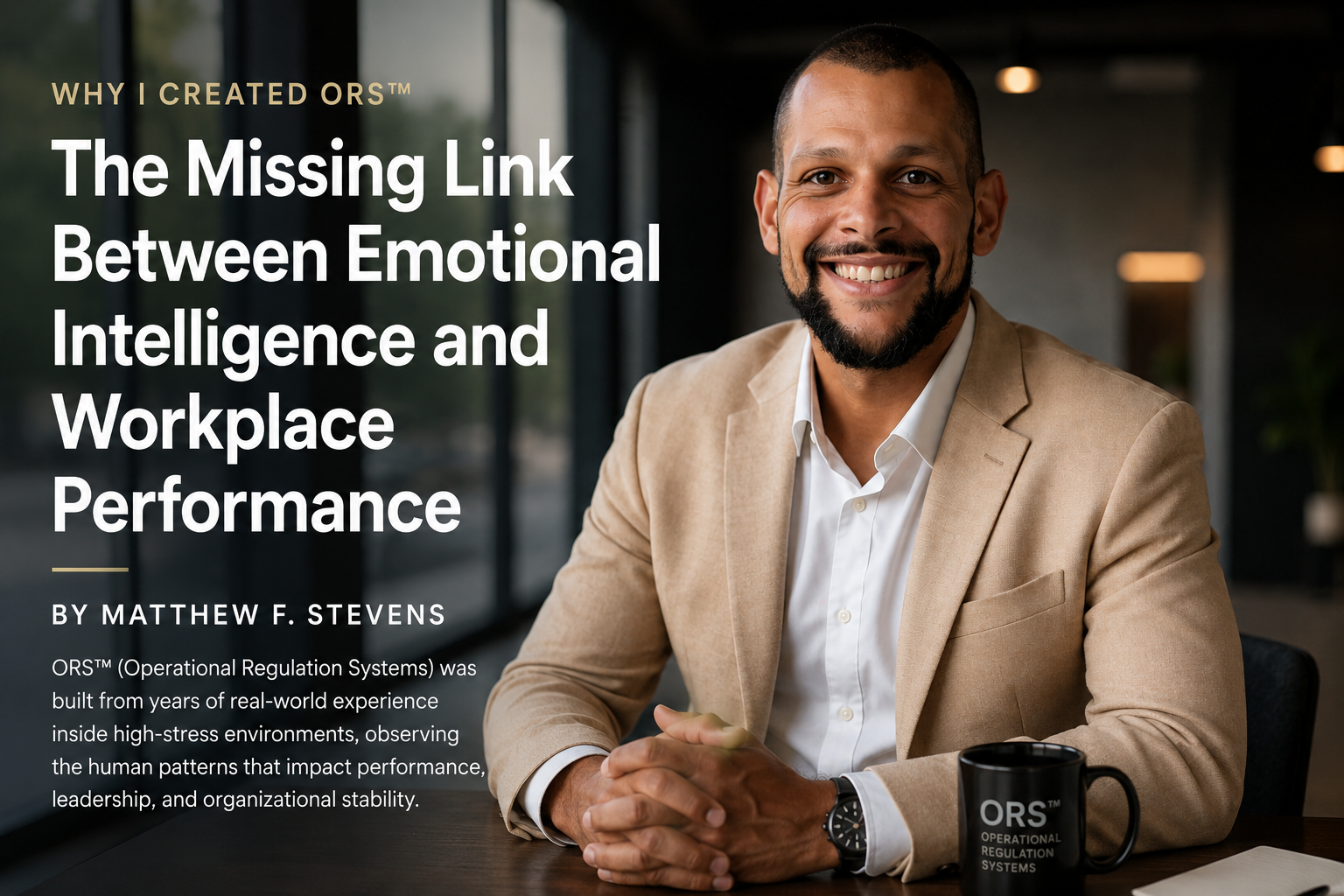
    That realization became the foundation for ORS™ (Operational Regulation Systems).

    I did not develop ORS™ from theory alone. I developed it through years of firsthand experience across multiple industries and high-stress environments.

    For most of my adult life, I worked helping children and families in emotionally intense situations. Over time, I witnessed the direct relationship between emotional regulation and human behavior.

    Children struggling with emotional regulation often displayed:

    • impulsive behavior
    • emotional reactivity
    • poor decision-making
    • instability under stress

    But the deeper insight came later.

    I began noticing many adults — including leadership teams, employees, and professionals — were struggling with the exact same underlying issues.

    Different age.
    Different environment.
    Same human mechanism.

    Over the years, I worked across multiple industries including:

    • youth services
    • residential treatment
    • manufacturing
    • customer service
    • construction
    • financial services

    Everywhere I went, I observed the same operational pattern:

    People were attempting to perform under chronic stress without the emotional intelligence skills necessary to regulate themselves effectively.

    I watched organizations struggle with:

    • burnout
    • absenteeism
    • communication breakdowns
    • workplace conflict
    • emotional exhaustion
    • inconsistent performance
    • high stress environments
    • poor recovery after pressure

    The issue was rarely a lack of capability.

    The issue was emotional regulation.

    Most people had never been taught how to:

    • regulate stress
    • recover emotionally
    • increase self-awareness
    • interrupt reactive behavior
    • improve emotional control under pressure

    Emotional Intelligence in the Workplace: Leadership, Stress, and Performance

    Eventually I began to understand something important:

    Emotional intelligence is not separate from performance.

    It drives performance.

    The most significant turning point came while working inside a global financial institution.

    I watched employees emotionally overwhelmed on a daily basis while leadership attempted to improve morale through surface-level engagement strategies that failed to address the deeper issue affecting the workforce.

    Then one of my coworkers died by suicide.

    Before his death, he openly communicated emotional pain to people around him, but many lacked the emotional awareness to fully recognize the severity of what he was experiencing.

    That moment permanently changed how I viewed emotional intelligence.

    I realized emotional intelligence was not simply about leadership development or communication skills.

    It was directly connected to human wellbeing, emotional recovery, workplace stability, and long-term performance sustainability.

    Around the same time, I watched employees sitting in parking lots crying after work.

    Something was clearly missing.

    Not only at the individual level, but within the systems themselves.

    That realization accelerated the development of ORS™.

    I began testing emotional regulation strategies on myself first.

    The results were measurable:

    • improved emotional regulation
    • increased emotional intelligence
    • stronger communication
    • improved self-awareness
    • faster recovery after stress
    • improved consistency under pressure
    • better decision-making

    After experiencing those improvements personally, I began testing ORS™ principles with other employees.

    The feedback remained remarkably consistent.

    Employees reported:

    • improved emotional awareness
    • better workplace communication
    • reduced emotional reactivity
    • stronger stress management
    • improved workplace relationships
    • increased consistency under pressure

    What became clear was simple:

    Emotional intelligence is not optional in high-stress environments.

    It is foundational.

    ORS™ was built from years of observing the same problem repeatedly across multiple industries:

    People struggle to perform consistently when emotional regulation is absent.

    Different industries.
    Different people.
    Same human mechanism.

    If you’re interested in learning how emotional intelligence and nervous system regulation impact workplace performance, leadership, and consistency under pressure, explore ORS™ at MatthewFStevens.com.

    Regulation → Awareness → Choice.

    — Matthew F. Stevens

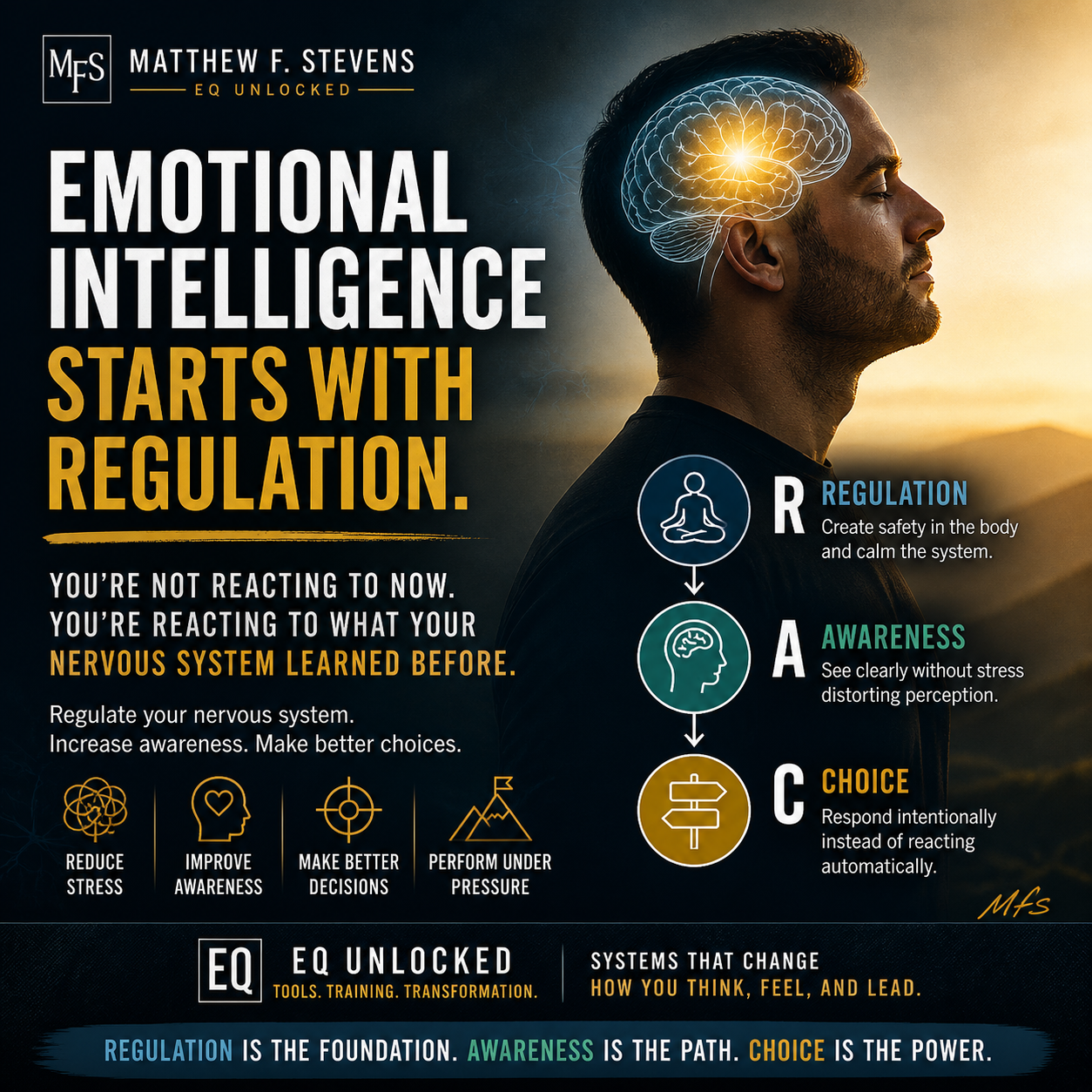
  • Emotional Intelligence Starts With Regulation

    Emotional Intelligence Starts With Regulation

    Most people think emotional intelligence is about communication skills, staying calm, or learning how to “manage emotions.”

    But emotional intelligence begins much deeper than behavior.

    It begins with regulation.

    Before someone can communicate clearly, make healthy decisions, or respond intentionally under pressure, their nervous system has to feel safe enough to allow awareness to exist without becoming overwhelmed.

    That changes everything.

    Why People Repeat the Same Patterns

    Many people are not reacting to the present moment.

    They are reacting to what their nervous system learned through repeated experiences over time.

    Stress. Rejection. Chaos. Criticism. Instability. Fear.

    Over time, the body learns survival patterns:

    • shutting down
    • overreacting
    • people pleasing
    • emotional withdrawal
    • anger
    • avoidance
    • hypervigilance
    • impulsive decision-making

    These responses are often mislabeled as personality flaws when they are actually conditioned nervous system responses.

    You cannot build lasting emotional intelligence while your body still believes survival is the priority.

    Awareness Without Regulation Can Feel Overwhelming

    This is where many people struggle.

    They become aware of their patterns, trauma, triggers, or behaviors—but awareness alone does not create change.

    In fact, awareness without regulation often increases shame, anxiety, frustration, or emotional flooding.

    That is why the order matters:

    REGULATION → AWARENESS → CHOICE

    When the nervous system becomes more regulated:

    • reactions slow down
    • thinking becomes clearer
    • self-awareness improves
    • communication changes
    • behavior becomes more intentional

    The goal is not emotional perfection.

    The goal is to create enough internal stability to choose differently rather than react automatically.

    Emotional Intelligence Is Built Through Repetition

    Real emotional intelligence is not built through motivation alone.

    It is built through repeated experiences that teach the nervous system:

    • safety
    • consistency
    • self-respect
    • accountability
    • emotional recovery
    • pause before reaction

    Small repeated behaviors reshape baseline responses over time.

    This is why consistency matters more than intensity.

    Tiny repeated choices:

    • taking a breath before reacting
    • pausing instead of escalating
    • communicating clearly
    • maintaining boundaries
    • following through on commitments
    • staying present under stress

    gradually recondition the nervous system.

    That is how emotional intelligence becomes embodied instead of intellectual.

    Emotional Intelligence Changes Every Area of Life

    When regulation improves, people often notice changes in:

    • relationships
    • leadership
    • parenting
    • performance under pressure
    • confidence
    • discipline
    • communication
    • self-respect

    Not because they became a different person overnight—
    but because they stopped operating from constant survival mode.

    A dysregulated nervous system distorts perception.

    A regulated nervous system increases clarity.

    Emotional intelligence impacts every area of life—from leadership and communication to stress management, relationships, and decision-making under pressure. Publications like Forbes continue emphasizing emotional intelligence as a critical factor in both personal and professional success.

    The Future of Emotional Intelligence

    The future of emotional intelligence is not just learning how to think differently.

    It is learning how to regulate differently.

    The more we understand the relationship between the nervous system, behavior, awareness, and decision-making, the more we realize:

    People are not weak because they struggle.

    Many have never learned regulation.

    And once regulation improves, awareness sharpens.

    When awareness sharpens, choices change.

    That is where transformation begins.

    Get your regulation baseline assessment here.


    Matthew F. Stevens
    Founder of NALS™, ORS™, and EQ Unlocked
    Helping individuals and organizations build emotional intelligence through nervous system regulation and structured behavioral systems.

  • The Hidden Reason Performance Under Stress Fails (What Most People Miss)

    The Hidden Reason Performance Under Stress Fails (What Most People Miss)

    Performance under stress is where many capable people suddenly break down. The issue is rarely a lack of training or knowledge. More often, it is the nervous system’s response to repeated stressful events. Most people try to improve performance by focusing on the outcomes they can measure.

    Productivity.
    Results.
    Metrics.
    Performance numbers.

    These things matter. They help us understand what is happening.

    But they are outcomes, not causes.

    When performance starts to decline, most people try to correct themselves. They push harder, work longer hours, or try to control behavior more tightly.

    What often goes unnoticed is something deeper:

    The role the nervous system plays in human performance.

    Understanding how stress affects the nervous system can completely change the way we think about emotional intelligence, leadership, and performance.


    When I First Saw the Pattern

    Years ago, I worked closely with young people who had experienced significant trauma. Performance under stress is an understatement.

    One of them was a young man named Dustin.

    I recently shared his story as the first case study on the EQ Unlocked podcast because his experience illustrates something I would later see repeated in many different environments.

    To many people, Dustin was difficult to work with. He was rough around the edges, stubborn, and at times openly defiant. Many people expected confrontation whenever he walked into a room.

    But over time something began to change.

    As Dustin and I continued working together, trust slowly developed between us. The more that trust grew, the more his behavior began to soften.

    The defiance people saw so clearly started to fade.

    His rough exterior softened.

    What stood out most to me was that this shift did not happen because Dustin suddenly learned new behavioral skills.

    It happened because something else changed.

    The calmer I remained—regardless of how he behaved—the more Dustin realized that the defenses he used to keep people at a distance were not necessary with me.

    His nervous system began to settle.

    And once that happened, everything else became easier.


    What Most People Miss About Emotional Regulation

    What I eventually realized was that Dustin did not lack awareness.

    He lacked regulation.

    When his nervous system was overwhelmed, his behavior became reactive. But when his nervous system was able to settle, something very different appeared.

    He became thoughtful.

    More cooperative.

    More open.

    The same person was there the entire time.

    What changed was his level of nervous system regulation.

    This insight completely changed the way I understood emotional intelligence.

    Stress responses are not only psychological; they are deeply physiological. In a class I attended taught by psychiatrist Bessel van der Kolk, I learned how the nervous system reacts to stress long before conscious thought has time to intervene. In his book The Body Keeps the Score, he explains how the body and nervous system store and respond to stress long before the thinking brain can catch up. When the nervous system becomes overwhelmed, performance often breaks down regardless of training or intention. This is why regulation matters. If the nervous system becomes overwhelmed first, awareness and choice often arrive too late.


    The Same Pattern Shows Up Everywhere

    Years later, I began noticing the same pattern in professional environments.

    Different setting.

    Same mechanism.

    Customer service agents who handled several difficult calls in a row would suddenly struggle to maintain the same patience and clarity they showed earlier in the day.

    Leaders managing constant pressure would begin reacting faster and thinking less clearly as stress accumulated.

    Most people interpret these situations as performance problems.

    But often the deeper issue is something else.

    Stress events are occurring faster than the nervous system can recover.

    When that happens, emotional regulation becomes more difficult, and performance begins to destabilize.


    Why More Training Often Doesn’t Solve the Problem

    Many people assume that performance problems can be solved simply by increasing awareness or providing more training.

    Training can be valuable. It increases knowledge and builds skills.

    But training assumes something important:

    That people will be able to access those skills under stress.

    When the nervous system becomes overwhelmed, access to higher-level thinking becomes limited.

    This is why people often know exactly what they should do but still struggle to do it in the moment.

    The issue is not knowledge.

    The issue is recovery between stress events.


    Stabilizing Performance Under Stress

    In high-pressure environments, stress events happen repeatedly throughout the day.

    A difficult conversation.

    An unexpected problem.

    A demanding interaction.

    Each of these events activates the nervous system.

    If recovery between those events happens quickly, performance remains stable.

    But when stress accumulates faster than the nervous system can recover, something begins to change.

    Reactions become quicker.

    Patience becomes thinner.

    Performance becomes inconsistent.

    What most people miss is that improving performance often requires stabilizing the human system behind the performance. I later built a structured approach to this problem through Operational Regulation Systems (ORS).


    The Foundation of Emotional Intelligence

    Many conversations about emotional intelligence focus on awareness.

    Others focus on decision-making.

    But something comes before both.

    Regulation.

    Because when the nervous system is stable, awareness improves.

    And when awareness improves, people make better choices.

    That sequence can be summarized simply:

    Regulation → Awareness → Choice

    Understanding this principle can fundamentally change the way we approach leadership, performance, and emotional intelligence.

    Because when the human system stabilizes, performance often stabilizes with it.


    Dustin’s Story

    Dustin’s story is explored in more detail in the EQ Unlocked Podcast, where I discuss how nervous system regulation shapes behavior, emotional intelligence, and performance under stress.