Tag: Workplace Performance

  • Why Your Call Center’s Turnover Problem Is Actually a Nervous System Problem

    Why Your Call Center’s Turnover Problem Is Actually a Nervous System Problem

    Call centers lose between 30 and 45 percent of their workforce every year.

    Most leadership teams treat that number as a hiring problem, a compensation problem, or a management problem.

    It isn’t any of those things.

    It is a nervous system problem. And until you treat it as one, the number will not change — regardless of how much you spend on recruiting, onboarding, or incentive programs.


    The Real Cost of Dysregulation in a Call Center

    When a call center agent is dysregulated — chronically stressed, emotionally flooded, or operating in a sustained state of threat response — several things happen simultaneously.

    Their prefrontal cortex, which governs impulse control, decision-making, and clear communication, goes partially offline. Their escalation rate increases. Their first-call resolution rate drops. Their after-call work time extends. And eventually, they leave — not because the job is too hard, but because the environment has given them no tools to manage what the job does to their nervous system.

    The replacement cost for one call center agent runs between $10,000 and $15,000 when recruitment, onboarding, and lost productivity are factored in. In a center with 200 agents and 40 percent annual turnover, that is $800,000 to $1.2 million spent annually — not on growth, not on technology, not on market expansion — on replacing people who should never have left.

    That number does not show up on a report labeled “dysregulation.”

    It shows up labeled “turnover,” “absenteeism,” “performance variance,” and “escalation costs.”

    But the root cause is the same in each case.

    What Dysregulation Actually Is

    Dysregulation is not stress. Everyone experiences stress.

    Dysregulation is what happens when stress has no recovery path — when the nervous system is activated repeatedly without the opportunity to return to baseline. In that state, the body and brain operate as if under constant threat. Decision-making narrows. Emotional reactivity increases. Performance becomes inconsistent. And over time, the person begins to withdraw — psychologically first, then physically.

    In a call center, this is not a rare condition. It is the default state for a significant portion of your workforce on any given day.


    Why Call Centers Manufacture Dysregulation

    A call center environment is physiologically demanding in ways that most operational frameworks do not account for.

    Agents absorb emotional labor on every call. They express emotions they do not feel, suppress emotions they do, and are evaluated on how well they manage that gap. Research consistently links this emotional dissonance — the distance between expressed and felt emotion — to exhaustion, disengagement, and increased intention to leave.

    Beyond the calls themselves, agents operate in:

    • High-noise, high-volume environments that keep the nervous system on alert
    • Compressed schedules with limited autonomy over pacing and recovery
    • Continuous performance monitoring that maintains a low-grade threat state
    • Back-to-back call queues with no structured recovery between difficult interactions
    • Inconsistent supervision that adds unpredictability to an already demanding environment

    Each of these factors independently activates the stress response. Together, they create a sustained sympathetic nervous system state that, without a recovery system, becomes the new baseline.

    The body does not distinguish between an angry customer and a physical threat. It responds the same way: elevated cortisol, narrowed cognitive function, and an accelerating drive toward escape.

    When the escape is not available in the moment — because they need the job — agents regulate through the only methods available: disengagement, absenteeism, and eventually resignation.

    This is not a character problem. It is a systems problem.

    The Financial Fingerprint of a Dysregulated Workforce

    Before an agent resigns, dysregulation leaves a measurable trail:

    Rising escalation rates — an agent who cannot regulate their own nervous system cannot de-escalate a customer’s.

    Declining first-call resolution — dysregulation narrows problem-solving. The brain in a stress state reaches for the fastest available exit, not the most effective solution.

    Increasing after-call work time — emotional recovery takes time the workflow does not build in, so it bleeds into post-call documentation.

    Widening performance variance — a dysregulated agent performs well on their best days and poorly on their worst, with no predictable middle. That inconsistency is expensive to manage and impossible to scale.

    Absenteeism patterns — the nervous system, given no structured recovery, takes recovery by force. Sick days spike. Call-outs increase. Attendance incentives become a cost center.

    Each of these is a measurable business metric. Each of them is downstream of the same unaddressed root cause.


    The Supervisor Problem Nobody Talks About

    Dysregulation does not stay at the agent level. It travels through teams.

    A dysregulated supervisor dysregulates every person beneath them.

    When a team lead operates from a chronic stress state — reactive, emotionally inconsistent, unpredictable in their responses — their team mirrors that state. Write-up rates increase. Team morale drops. Performance variance widens across the unit, not just in individual agents.

    Most supervisors in call centers were promoted because they were exceptional agents. They were not trained to:

    • Identify dysregulation in a team member before it becomes a conduct issue
    • Regulate themselves before entering a difficult conversation
    • Use language that de-escalates rather than triggers defensive responses
    • Recognize when their own state is affecting their team’s performance

    That gap — between what they are expected to do and what they were prepared for — is where dysregulation spreads from individual agents into entire teams. And from teams into floor-wide performance metrics.

    This is the invisible multiplier in your turnover equation. A dysregulated supervisor does not just struggle themselves. They amplify the dysregulation of everyone around them.


    What a Nervous System Solution Looks Like

    Most approaches to call center performance address symptoms. Incentive programs reward attendance without addressing why people aren’t attending. Training programs improve scripts without addressing why agents can’t access those scripts under pressure. Wellness offerings provide gym memberships while the environment that requires the gym remains unchanged.

    ORS — Operational Regulation Systems — addresses the root.

    Built specifically for high-volume, high-stress operational environments, ORS works at three distinct levels — because the problem exists at three levels.

    Level 1 — The Agent

    ORS installs regulation checkpoints into the existing workflow without disrupting handle time or operational flow.

    Pre-shift protocol (4 minutes): A structured nervous system preparation practice before the first call. This is not meditation. It is a physiological priming sequence that moves the agent from whatever state they arrived in to a regulated baseline before they touch a headset.

    In-call micro-regulation: Techniques agents use in real time — during holds, between call phases, in moments of customer escalation — that interrupt the stress response before it affects performance. These are designed to be invisible to the customer and compatible with call monitoring.

    Post-call recovery protocol: A structured 60-to-90-second reset between calls that prevents emotional carryover. This is the single most underutilized intervention available in call center operations. The industry knows that hard calls affect subsequent performance. ORS builds the recovery system that breaks that chain.

    Metrics this moves: Escalation rate. First-call resolution. After-call work time. Agent consistency score. Attendance patterns.

    Level 2 — The Supervisor

    ORS provides supervisors with the specific capabilities their promotion did not include.

    Dysregulation identification: How to recognize when a team member is approaching a dysregulation threshold before it manifests as a performance or conduct issue — and what to do at that point.

    Self-regulation first: How to assess and regulate their own state before any difficult conversation, performance review, or team interaction. A supervisor who enters a correction conversation dysregulated will dysregulate the person they are correcting. ORS breaks this pattern.

    De-escalation language: Specific communication frameworks that address behavior without triggering defensive responses — the difference between a conversation that produces behavior change and one that produces a grievance.

    Metrics this moves: Team performance variance. Write-up volume. Team-level retention. Supervisor confidence and consistency scores.

    Level 3 — The Operation

    This is where most programs stop short.

    ORS audits the operational decisions that manufacture dysregulation in the first place.

    Scheduling design. Break structure and placement. Call queue management. Performance review language. Escalation protocols. Attendance policy framing.

    Each of these operational decisions either increases or decreases the nervous system load of your workforce. Most were designed without that consideration. ORS identifies which decisions are costing you the most in regulation terms — and provides specific, implementable modifications.

    This is not a culture initiative. It is an operational audit with specific deliverables. The goal is not to make the workplace feel better. It is to make it function better by removing the systemic conditions that make regulation impossible.

    Metrics this moves: Systemic stress load. Workforce retention rate. Cost-per-agent over a 90-day measurement period.


    The Business Case for a Pilot

    The question is not whether your call center has a regulation problem. At scale, every call center does.

    The question is what that problem is currently costing you — and what it would cost to address it with precision.

    A 60-day ORS pilot on one team provides a clean, controlled answer.

    The pilot team’s performance is measured against its own baseline and against a comparable non-pilot team. At 30 days, a mid-point review identifies what is moving and what needs adjustment. At 60 days, a full results report provides specific data on which metrics moved, by how much, and what the ROI looks like before any decision is made about broader implementation.

    At the end of 60 days, you have one of two things: data that justifies scaling — or data that tells you what to refine.

    Either way, you have something most organizations never develop for this problem: a measurable answer.

    The pilot investment is a fraction of one month’s cost of the problem it is designed to solve.

    That is not a budget conversation. That is an ROI conversation.


    About the Author

    Matthew F. Stevens is the founder of ORS (Operational Regulation Systems) and NALS (Neuro Advanced Learning Systems), and the host of EQ Unlocked. He is certified as a Trauma and Resilience Practitioner through Starr Commonwealth, certified in Neuro-Linguistic Programming, and has trained under Dr. Bruce Perry and Dr. Bessel van der Kolk. His work sits at the intersection of neuroscience, emotional intelligence, and operational performance — building systems that change how organizations function from the nervous system up.


    Frequently Asked Questions

    What is dysregulation in a workplace context?

    Dysregulation refers to a state in which the nervous system is operating in a sustained stress response rather than a regulated baseline. In a call center, this manifests as emotional reactivity, inconsistent performance, poor communication under pressure, and increased absenteeism and turnover intention. It is not a personality trait. It is a physiological state — and physiological states can be changed with the right system.

    How is ORS different from an employee wellness program?

    Wellness programs address symptoms. ORS addresses the operational conditions that produce the symptoms. A gym stipend does not change how an agent’s nervous system responds to their fourteenth difficult call of the day. ORS changes the workflow and environment so the nervous system has a structured recovery path built into the operational design — not offered as an optional benefit.

    How quickly can ORS show measurable results?

    A 60-day pilot typically shows movement in escalation rates and consistency scores within the first 30 days. Turnover impact is measured across the full pilot period against a baseline established at day one. Supervisor-level metrics often move faster than agent-level metrics because supervisors have more direct control over their own behavior.

    What industries beyond call centers does ORS serve?

    ORS is applicable to any high-volume, high-stress operational environment — healthcare, logistics, retail operations, financial services, and any organization where human performance is the primary operational variable. The nervous system principles are consistent across industries. The implementation is customized to the operational context.

    What does an ORS engagement begin with?

    Every ORS engagement begins with a 30-minute discovery conversation in which we examine your current performance data together and identify where dysregulation is the root cause of what you’re already measuring. No commitment is required at that stage. The conversation either confirms that ORS is the right fit — or tells us both that it isn’t. Either outcome is useful.

    How do I learn more about ORS?

    Use the contact form below or visit the ORS services page to schedule a discovery conversation.

    ORS — Operational Regulation Systems — addresses the root.

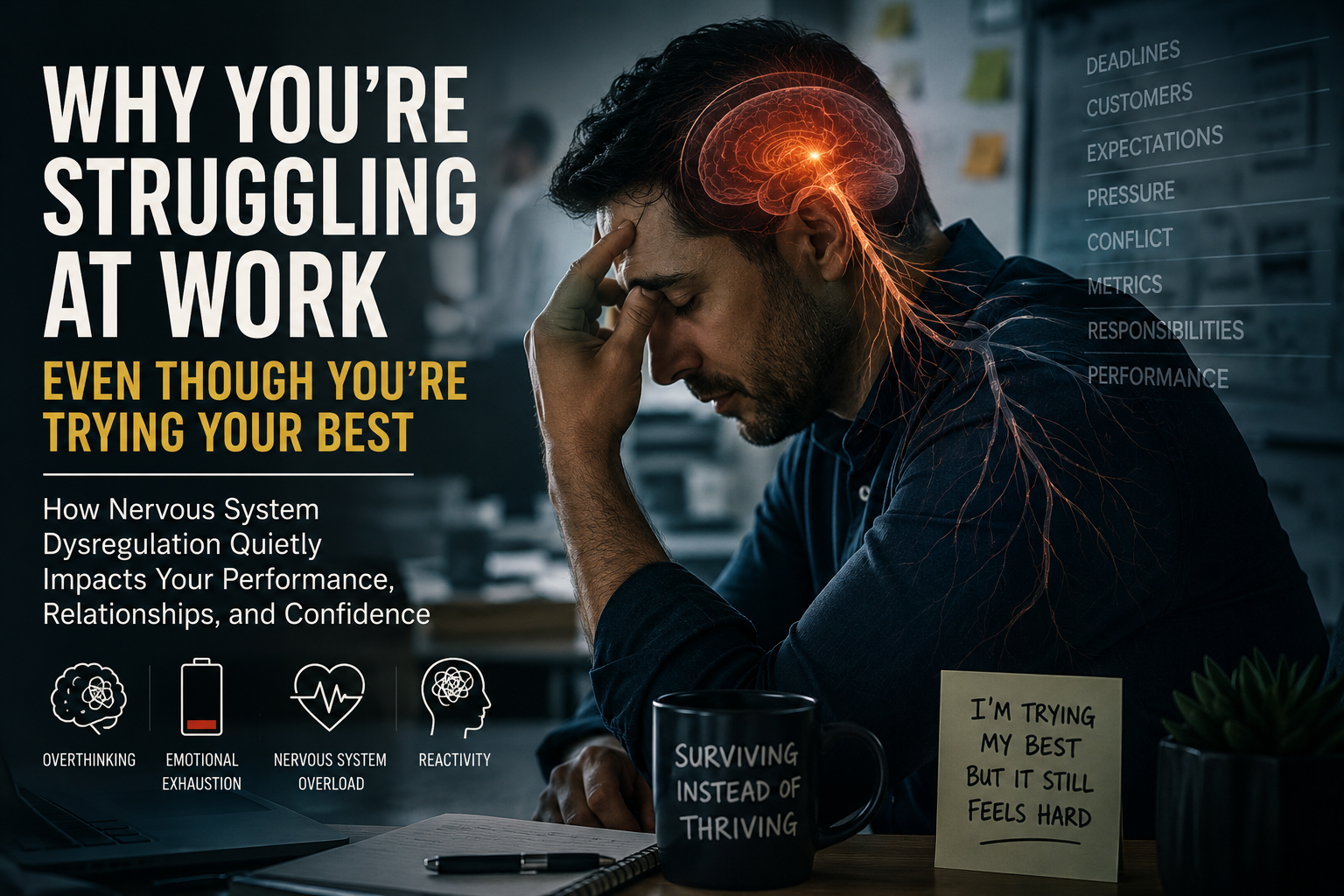
  • Why You’re Struggling at Work Even Though You’re Trying Your Best

    Why You’re Struggling at Work Even Though You’re Trying Your Best

    How Nervous System Dysregulation Quietly Impacts Your Performance, Relationships, and Confidence

    By Matthew F. Stevens

    For years, I believed work performance was mostly about discipline.

    I thought if people simply worked harder, stayed focused, or cared more, they would naturally improve. I knew people were struggling at work, but I thought why not just put it aside and get the job done.

    Then life humbled me.

    I worked in factories.
    Medical Facilities.
    High-pressure environments.


    Places where numbers mattered, emotions were ignored, and stress slowly became normal.

    And I began noticing something that changed the way I viewed people forever:

    Many employees are not failing because they are lazy.
    They are struggling because their nervous systems are overloaded,

    The scary part is that most people do not even realize it is happening.

    They simply think: What if the issue is deeper than motivation?

    “I’m burned out.”

    “I can’t focus.”

    “I’m too emotional.”

    “I’m always anxious.”

    “I keep messing up.”

    “Why do small things overwhelm me?”

    “Why do I react so strongly?”

    “Why am I exhausted after work every day?”

    What if the issue is deeper than struggling at work?

    What if your nervous system has spent so much time surviving stress that it no longer knows how to rest, recover, or regulate itself properly?


    The Workplace Is Quietly Keeping Many People in Survival Mode

    Most companies focus heavily on outcomes:

    Productivity

    Attendance

    Customer service

    Compliance

    Performance metrics

    Sales goals

    Speed

    Accuracy

    But very few people stop to ask:

    What condition is the nervous system in that is producing these outcomes?

    Because when your nervous system becomes chronically dysregulated, work begins affecting you differently.

    How Chronic Stress Impacts Daily Work Performance

    You may notice:

    You feel mentally exhausted faster than others

    Small problems feel enormous

    Criticism feels deeply personal

    You struggle to recover after stressful calls or interactions

    You overthink conversations long after they happen

    You become emotionally reactive under pressure

    Your confidence fluctuates constantly

    You feel overwhelmed by simple tasks

    You procrastinate even when you care deeply

    You become hyperaware of people’s tone, expressions, or energy

    You dread going to work before the day even begins

    This is not a weakness.

    This is what survival physiology feels like when it becomes chronic.


    My Own Experience Changed Everything

    There was a period in my life where I believed I was simply “bad at being an employee.”

    I had spent years helping children and families through intense trauma work. Then life forced me into entirely different environments.

    Factories.
    Corporate structures.
    Call centers.

    At first, I hated it.

    But eventually I realized something important:

    The workplace itself was showing me human nervous systems in real time.

    I watched highly intelligent people completely lose emotional control over small stressors.

    I watched managers shut down under pressure.

    I watched employees carry trauma into customer interactions without realizing it.

    I watched people become increasingly reactive throughout the shift until they no longer sounded like themselves.

    And I recognized something uncomfortable:

    I was doing it too.

    There were moments where my body was at work, but my nervous system was somewhere else entirely.

    Still carrying stress.
    Still carrying survival patterns.
    Still preparing for danger even when no danger existed.

    That realization changed the direction of my life.


    Chronic Stress Changes the Way You Think

    When your nervous system stays activated too long, your brain begins prioritizing survival over clarity.

    This affects:

    Memory

    Emotional control

    Decision-making

    Focus

    Patience

    Communication

    Self-awareness

    Confidence

    Problem-solving

    This is why dysregulated employees often experience:

    Emotional Exhaustion

    You are tired before the day even starts because your body never fully recovered from yesterday.

    Overthinking

    Your nervous system constantly scans for threats, mistakes, rejection, or danger.

    Reactivity

    You become more likely to snap, shut down, withdraw, or emotionally spiral.

    Brain Fog

    Simple tasks suddenly feel harder than they should.

    Inconsistent Performance

    Some days you perform exceptionally well. Other days you feel like you can barely function.

    Difficulty Handling Feedback

    Corrections feel emotionally overwhelming instead of informative.

    Escalated Anxiety

    Your body reacts to emails, meetings, customers, deadlines, and conflict as if survival is at stake.


    The Nervous System Does Not Care About Your Job Title

    One thing I have learned is this:

    Trauma and chronic stress do not disappear because you clock into work.

    People carry entire histories into workplaces.

    Loss.
    Abandonment.
    Fear.
    Shame.
    Childhood instability.
    Financial stress.
    Relationship pain.
    Emotional neglect.

    Most people never learned regulation.

    They learned survival.

    So when pressure rises, the nervous system falls back on old patterns:

    Defensiveness

    Avoidance

    People pleasing

    Anger

    Withdrawal

    Shutdown

    Overworking

    Perfectionism

    Hypervigilance

    And many employees silently blame themselves for reactions they do not yet understand.


    Why Awareness Alone Often Makes Things Worse

    One of the hardest truths I had to learn was this:

    Awareness without regulation can become torture.

    You may fully understand your patterns and still feel unable to stop them.

    You know you are overreacting.
    You know you are spiraling.
    You know you are exhausted.

    But your nervous system is already activated.

    This is why the framework I teach is:

    Regulation → Awareness → Choice

    Not awareness first.

    Because when the nervous system becomes more regulated:

    Thinking becomes clearer

    Recovery becomes faster

    Emotions become easier to process

    Communication improves

    Confidence stabilizes

    Decision-making improves

    Self-awareness becomes safer

    Without regulation, awareness often turns into rumination and self-criticism.


    What Regulation Actually Looks Like at Work

    Regulation is not pretending to be calm.

    It is not suppressing emotions.

    It is not “positive thinking.”

    Real regulation looks more like:

    Recovering faster after stress

    Breathing intentionally during activation

    Not allowing one bad moment to ruin your entire day

    Catching yourself before escalation

    Returning to baseline quicker

    Becoming less emotionally impulsive

    Remaining present during pressure

    Feeling emotions without becoming consumed by them

    This changes work performance dramatically over time.

    Because stable nervous systems create more stable behavior.


    The Day I Realized Performance Begins With Regulation

    One of the biggest realizations of my life came after losing over 250 pounds.

    People asked me about discipline constantly.

    But the truth was deeper than discipline.

    The transformation only became sustainable once my nervous system became more regulated.

    Because dysregulated people struggle with consistency.

    Not because they are incapable.

    Because survival mode destroys stability.

    That same principle exists in workplaces everywhere.

    Employees often do not need more shame.
    They need recovery.
    They need nervous system stability.
    They need tools that help them return to baseline faster.


    You Are Not Broken

    Many people secretly believe they are failing at life because they struggle under pressure.

    But often what they are truly experiencing is a nervous system that adapted to survive difficult environments.

    And survival patterns that once protected you may now be interfering with your growth.

    The good news is this:

    Nervous systems can change.

    Recovery speed can improve.

    Self-awareness can grow.

    Emotional regulation can be strengthened.

    And performance often improves naturally once the nervous system begins stabilizing.


    Final Thoughts

    The modern workplace is filled with people silently operating in survival mode.

    People who are intelligent.
    Capable.
    Hardworking.
    Talented.

    But overwhelmed internally.

    Understanding nervous system regulation changed the way I viewed performance forever.

    Because behind many struggles at work is not a lack of intelligence.

    It is an overloaded nervous system trying to survive another day.

    And once people begin learning how to regulate themselves, recover faster, and return to baseline under pressure, something powerful happens:

    Emotional intelligence strengthens.

    They stop merely surviving work.

    And begin functioning from stability instead.


    Matthew F. Stevens is the creator of ORS™ (Operational Regulation Systems) and host of EQ Unlocked, a platform focused on emotional regulation, nervous system stability, and human performance under pressure.

    Take the Regulation Baseline Assessment to better understand how stress and nervous system dysregulation may be impacting your daily life and work performance.

    The American Psychological Association provides additional research on how chronic stress affects the brain and body.