Tag: eq unlocked

  • Why You’re Struggling at Work Even Though You’re Trying Your Best

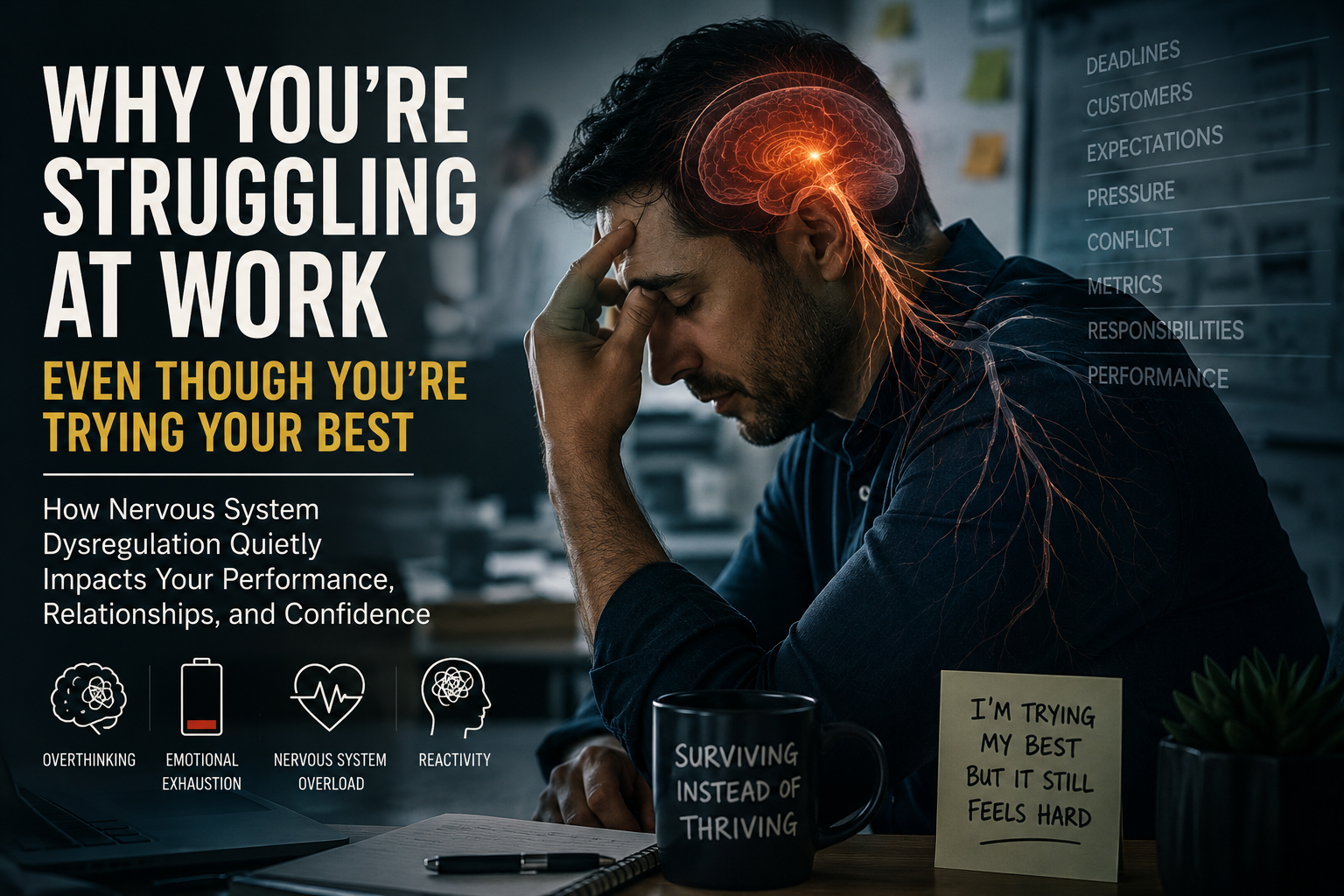
    Why You’re Struggling at Work Even Though You’re Trying Your Best

    How Nervous System Dysregulation Quietly Impacts Your Performance, Relationships, and Confidence

    By Matthew F. Stevens

    For years, I believed work performance was mostly about discipline.

    I thought if people simply worked harder, stayed focused, or cared more, they would naturally improve. I knew people were struggling at work, but I thought why not just put it aside and get the job done.

    Then life humbled me.

    I worked in factories.
    Medical Facilities.
    High-pressure environments.


    Places where numbers mattered, emotions were ignored, and stress slowly became normal.

    And I began noticing something that changed the way I viewed people forever:

    Many employees are not failing because they are lazy.
    They are struggling because their nervous systems are overloaded,

    The scary part is that most people do not even realize it is happening.

    They simply think: What if the issue is deeper than motivation?

    “I’m burned out.”

    “I can’t focus.”

    “I’m too emotional.”

    “I’m always anxious.”

    “I keep messing up.”

    “Why do small things overwhelm me?”

    “Why do I react so strongly?”

    “Why am I exhausted after work every day?”

    What if the issue is deeper than struggling at work?

    What if your nervous system has spent so much time surviving stress that it no longer knows how to rest, recover, or regulate itself properly?


    The Workplace Is Quietly Keeping Many People in Survival Mode

    Most companies focus heavily on outcomes:

    Productivity

    Attendance

    Customer service

    Compliance

    Performance metrics

    Sales goals

    Speed

    Accuracy

    But very few people stop to ask:

    What condition is the nervous system in that is producing these outcomes?

    Because when your nervous system becomes chronically dysregulated, work begins affecting you differently.

    How Chronic Stress Impacts Daily Work Performance

    You may notice:

    You feel mentally exhausted faster than others

    Small problems feel enormous

    Criticism feels deeply personal

    You struggle to recover after stressful calls or interactions

    You overthink conversations long after they happen

    You become emotionally reactive under pressure

    Your confidence fluctuates constantly

    You feel overwhelmed by simple tasks

    You procrastinate even when you care deeply

    You become hyperaware of people’s tone, expressions, or energy

    You dread going to work before the day even begins

    This is not a weakness.

    This is what survival physiology feels like when it becomes chronic.


    My Own Experience Changed Everything

    There was a period in my life where I believed I was simply “bad at being an employee.”

    I had spent years helping children and families through intense trauma work. Then life forced me into entirely different environments.

    Factories.
    Corporate structures.
    Call centers.

    At first, I hated it.

    But eventually I realized something important:

    The workplace itself was showing me human nervous systems in real time.

    I watched highly intelligent people completely lose emotional control over small stressors.

    I watched managers shut down under pressure.

    I watched employees carry trauma into customer interactions without realizing it.

    I watched people become increasingly reactive throughout the shift until they no longer sounded like themselves.

    And I recognized something uncomfortable:

    I was doing it too.

    There were moments where my body was at work, but my nervous system was somewhere else entirely.

    Still carrying stress.
    Still carrying survival patterns.
    Still preparing for danger even when no danger existed.

    That realization changed the direction of my life.


    Chronic Stress Changes the Way You Think

    When your nervous system stays activated too long, your brain begins prioritizing survival over clarity.

    This affects:

    Memory

    Emotional control

    Decision-making

    Focus

    Patience

    Communication

    Self-awareness

    Confidence

    Problem-solving

    This is why dysregulated employees often experience:

    Emotional Exhaustion

    You are tired before the day even starts because your body never fully recovered from yesterday.

    Overthinking

    Your nervous system constantly scans for threats, mistakes, rejection, or danger.

    Reactivity

    You become more likely to snap, shut down, withdraw, or emotionally spiral.

    Brain Fog

    Simple tasks suddenly feel harder than they should.

    Inconsistent Performance

    Some days you perform exceptionally well. Other days you feel like you can barely function.

    Difficulty Handling Feedback

    Corrections feel emotionally overwhelming instead of informative.

    Escalated Anxiety

    Your body reacts to emails, meetings, customers, deadlines, and conflict as if survival is at stake.


    The Nervous System Does Not Care About Your Job Title

    One thing I have learned is this:

    Trauma and chronic stress do not disappear because you clock into work.

    People carry entire histories into workplaces.

    Loss.
    Abandonment.
    Fear.
    Shame.
    Childhood instability.
    Financial stress.
    Relationship pain.
    Emotional neglect.

    Most people never learned regulation.

    They learned survival.

    So when pressure rises, the nervous system falls back on old patterns:

    Defensiveness

    Avoidance

    People pleasing

    Anger

    Withdrawal

    Shutdown

    Overworking

    Perfectionism

    Hypervigilance

    And many employees silently blame themselves for reactions they do not yet understand.


    Why Awareness Alone Often Makes Things Worse

    One of the hardest truths I had to learn was this:

    Awareness without regulation can become torture.

    You may fully understand your patterns and still feel unable to stop them.

    You know you are overreacting.
    You know you are spiraling.
    You know you are exhausted.

    But your nervous system is already activated.

    This is why the framework I teach is:

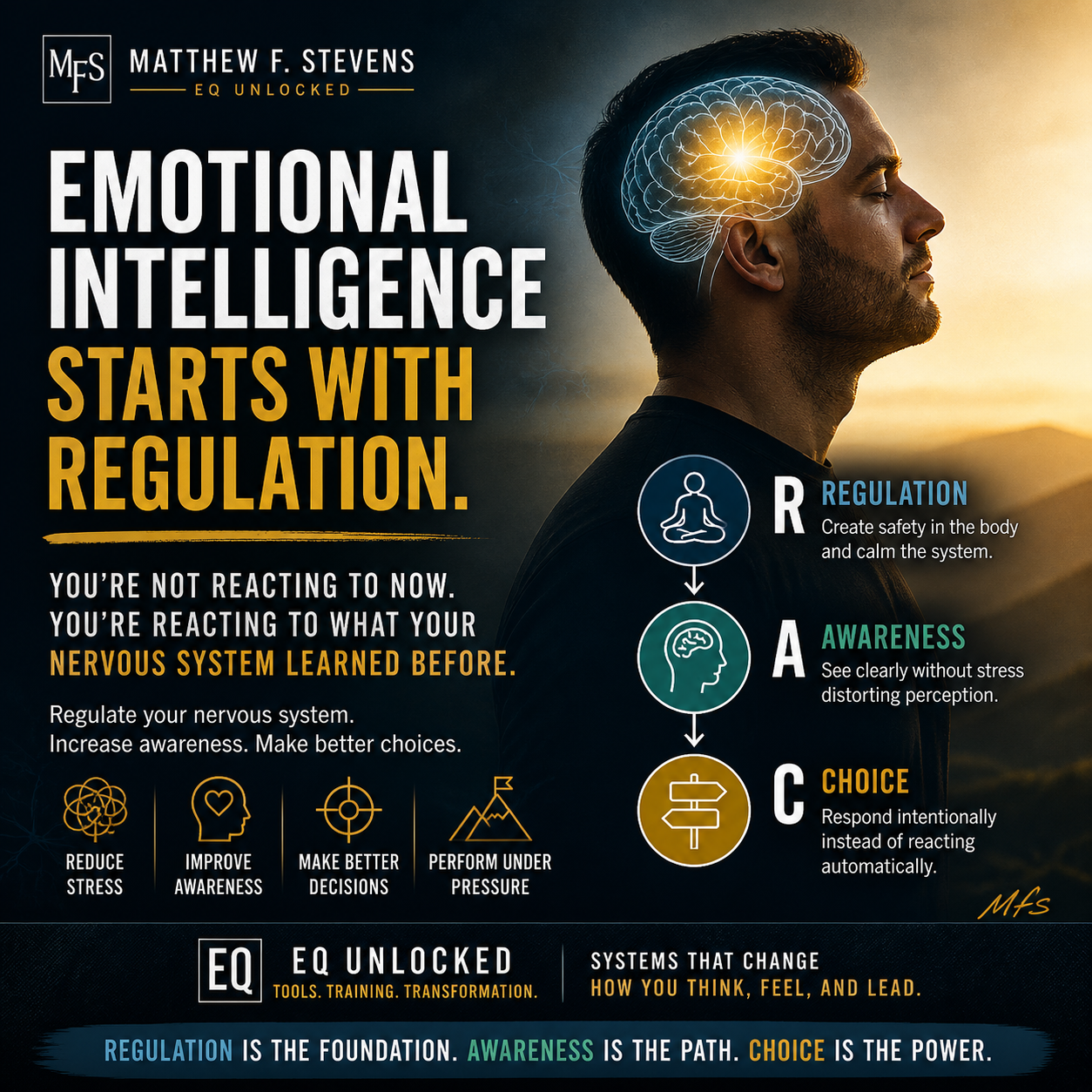
    Regulation → Awareness → Choice

    Not awareness first.

    Because when the nervous system becomes more regulated:

    Thinking becomes clearer

    Recovery becomes faster

    Emotions become easier to process

    Communication improves

    Confidence stabilizes

    Decision-making improves

    Self-awareness becomes safer

    Without regulation, awareness often turns into rumination and self-criticism.


    What Regulation Actually Looks Like at Work

    Regulation is not pretending to be calm.

    It is not suppressing emotions.

    It is not “positive thinking.”

    Real regulation looks more like:

    Recovering faster after stress

    Breathing intentionally during activation

    Not allowing one bad moment to ruin your entire day

    Catching yourself before escalation

    Returning to baseline quicker

    Becoming less emotionally impulsive

    Remaining present during pressure

    Feeling emotions without becoming consumed by them

    This changes work performance dramatically over time.

    Because stable nervous systems create more stable behavior.


    The Day I Realized Performance Begins With Regulation

    One of the biggest realizations of my life came after losing over 250 pounds.

    People asked me about discipline constantly.

    But the truth was deeper than discipline.

    The transformation only became sustainable once my nervous system became more regulated.

    Because dysregulated people struggle with consistency.

    Not because they are incapable.

    Because survival mode destroys stability.

    That same principle exists in workplaces everywhere.

    Employees often do not need more shame.
    They need recovery.
    They need nervous system stability.
    They need tools that help them return to baseline faster.


    You Are Not Broken

    Many people secretly believe they are failing at life because they struggle under pressure.

    But often what they are truly experiencing is a nervous system that adapted to survive difficult environments.

    And survival patterns that once protected you may now be interfering with your growth.

    The good news is this:

    Nervous systems can change.

    Recovery speed can improve.

    Self-awareness can grow.

    Emotional regulation can be strengthened.

    And performance often improves naturally once the nervous system begins stabilizing.


    Final Thoughts

    The modern workplace is filled with people silently operating in survival mode.

    People who are intelligent.
    Capable.
    Hardworking.
    Talented.

    But overwhelmed internally.

    Understanding nervous system regulation changed the way I viewed performance forever.

    Because behind many struggles at work is not a lack of intelligence.

    It is an overloaded nervous system trying to survive another day.

    And once people begin learning how to regulate themselves, recover faster, and return to baseline under pressure, something powerful happens:

    Emotional intelligence strengthens.

    They stop merely surviving work.

    And begin functioning from stability instead.


    Matthew F. Stevens is the creator of ORS™ (Operational Regulation Systems) and host of EQ Unlocked, a platform focused on emotional regulation, nervous system stability, and human performance under pressure.

    Take the Regulation Baseline Assessment to better understand how stress and nervous system dysregulation may be impacting your daily life and work performance.

    The American Psychological Association provides additional research on how chronic stress affects the brain and body.

  • Emotional Intelligence Is the Missing Variable Behind Workplace Performance

    Emotional Intelligence Is the Missing Variable Behind Workplace Performance

    For years, I watched organizations focus on productivity, compliance, engagement, and performance while overlooking one of the most important drivers of human behavior:

    Emotional intelligence.

    Not emotional intelligence as a buzzword.
    Not motivational posters or corporate slogans.

    Real emotional intelligence.

    The ability to regulate emotions, recover under pressure, communicate effectively, maintain self-awareness, and make sound decisions during stress.

    Research and leadership literature from sources like Harvard Business Review has increasingly highlighted the role emotional intelligence plays in leadership, communication, and organizational performance.

    What I eventually realized was this:

    Most performance problems are not intelligence problems.

    They are emotional intelligence problems.

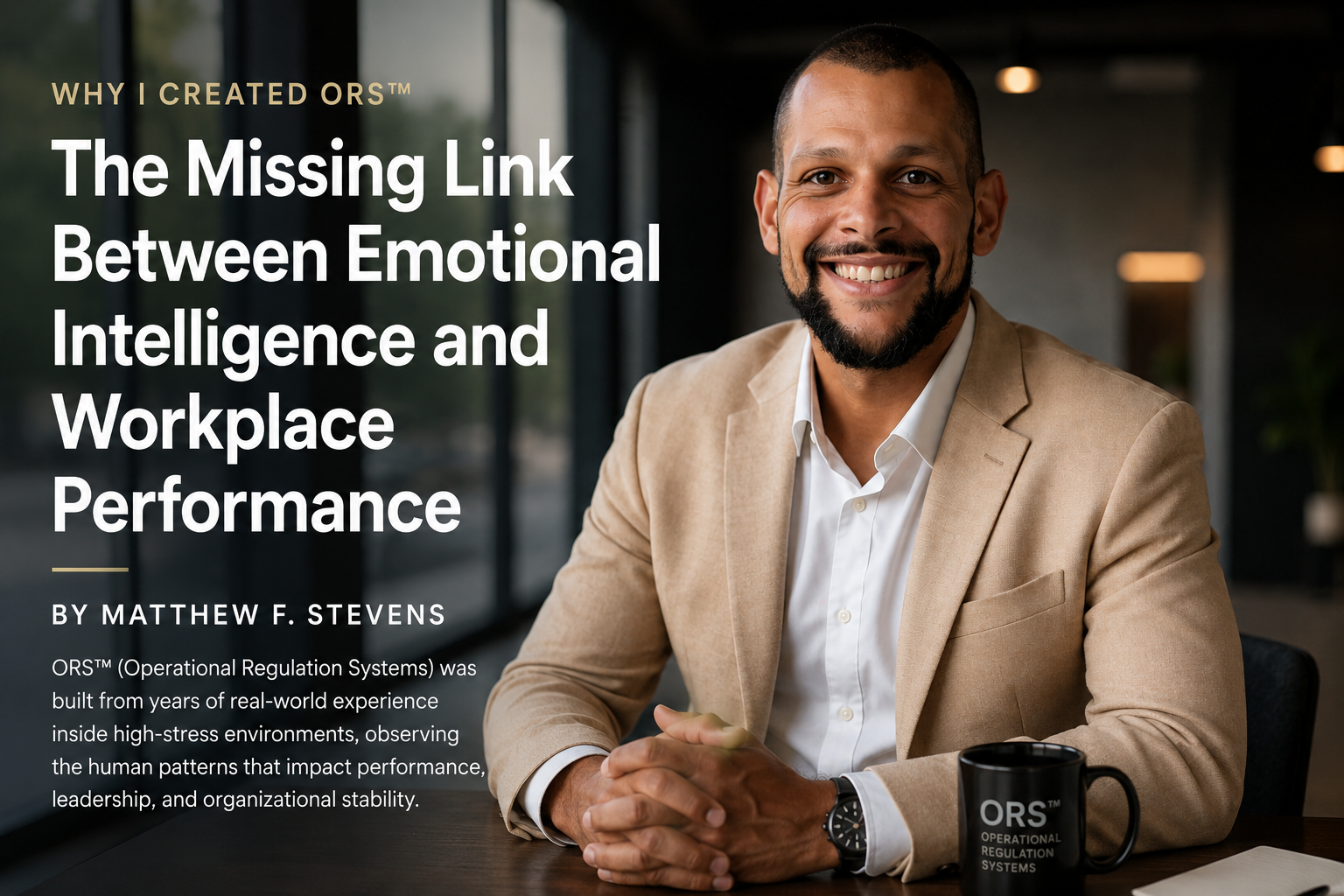
    That realization became the foundation for ORS™ (Operational Regulation Systems).

    I did not develop ORS™ from theory alone. I developed it through years of firsthand experience across multiple industries and high-stress environments.

    For most of my adult life, I worked helping children and families in emotionally intense situations. Over time, I witnessed the direct relationship between emotional regulation and human behavior.

    Children struggling with emotional regulation often displayed:

    • impulsive behavior
    • emotional reactivity
    • poor decision-making
    • instability under stress

    But the deeper insight came later.

    I began noticing many adults — including leadership teams, employees, and professionals — were struggling with the exact same underlying issues.

    Different age.
    Different environment.
    Same human mechanism.

    Over the years, I worked across multiple industries including:

    • youth services
    • residential treatment
    • manufacturing
    • customer service
    • construction
    • financial services

    Everywhere I went, I observed the same operational pattern:

    People were attempting to perform under chronic stress without the emotional intelligence skills necessary to regulate themselves effectively.

    I watched organizations struggle with:

    • burnout
    • absenteeism
    • communication breakdowns
    • workplace conflict
    • emotional exhaustion
    • inconsistent performance
    • high stress environments
    • poor recovery after pressure

    The issue was rarely a lack of capability.

    The issue was emotional regulation.

    Most people had never been taught how to:

    • regulate stress
    • recover emotionally
    • increase self-awareness
    • interrupt reactive behavior
    • improve emotional control under pressure

    Emotional Intelligence in the Workplace: Leadership, Stress, and Performance

    Eventually I began to understand something important:

    Emotional intelligence is not separate from performance.

    It drives performance.

    The most significant turning point came while working inside a global financial institution.

    I watched employees emotionally overwhelmed on a daily basis while leadership attempted to improve morale through surface-level engagement strategies that failed to address the deeper issue affecting the workforce.

    Then one of my coworkers died by suicide.

    Before his death, he openly communicated emotional pain to people around him, but many lacked the emotional awareness to fully recognize the severity of what he was experiencing.

    That moment permanently changed how I viewed emotional intelligence.

    I realized emotional intelligence was not simply about leadership development or communication skills.

    It was directly connected to human wellbeing, emotional recovery, workplace stability, and long-term performance sustainability.

    Around the same time, I watched employees sitting in parking lots crying after work.

    Something was clearly missing.

    Not only at the individual level, but within the systems themselves.

    That realization accelerated the development of ORS™.

    I began testing emotional regulation strategies on myself first.

    The results were measurable:

    • improved emotional regulation
    • increased emotional intelligence
    • stronger communication
    • improved self-awareness
    • faster recovery after stress
    • improved consistency under pressure
    • better decision-making

    After experiencing those improvements personally, I began testing ORS™ principles with other employees.

    The feedback remained remarkably consistent.

    Employees reported:

    • improved emotional awareness
    • better workplace communication
    • reduced emotional reactivity
    • stronger stress management
    • improved workplace relationships
    • increased consistency under pressure

    What became clear was simple:

    Emotional intelligence is not optional in high-stress environments.

    It is foundational.

    ORS™ was built from years of observing the same problem repeatedly across multiple industries:

    People struggle to perform consistently when emotional regulation is absent.

    Different industries.
    Different people.
    Same human mechanism.

    If you’re interested in learning how emotional intelligence and nervous system regulation impact workplace performance, leadership, and consistency under pressure, explore ORS™ at MatthewFStevens.com.

    Regulation → Awareness → Choice.

    — Matthew F. Stevens

  • Emotional Intelligence Starts With Regulation

    Emotional Intelligence Starts With Regulation

    Most people think emotional intelligence is about communication skills, staying calm, or learning how to “manage emotions.”

    But emotional intelligence begins much deeper than behavior.

    It begins with regulation.

    Before someone can communicate clearly, make healthy decisions, or respond intentionally under pressure, their nervous system has to feel safe enough to allow awareness to exist without becoming overwhelmed.

    That changes everything.

    Why People Repeat the Same Patterns

    Many people are not reacting to the present moment.

    They are reacting to what their nervous system learned through repeated experiences over time.

    Stress. Rejection. Chaos. Criticism. Instability. Fear.

    Over time, the body learns survival patterns:

    • shutting down
    • overreacting
    • people pleasing
    • emotional withdrawal
    • anger
    • avoidance
    • hypervigilance
    • impulsive decision-making

    These responses are often mislabeled as personality flaws when they are actually conditioned nervous system responses.

    You cannot build lasting emotional intelligence while your body still believes survival is the priority.

    Awareness Without Regulation Can Feel Overwhelming

    This is where many people struggle.

    They become aware of their patterns, trauma, triggers, or behaviors—but awareness alone does not create change.

    In fact, awareness without regulation often increases shame, anxiety, frustration, or emotional flooding.

    That is why the order matters:

    REGULATION → AWARENESS → CHOICE

    When the nervous system becomes more regulated:

    • reactions slow down
    • thinking becomes clearer
    • self-awareness improves
    • communication changes
    • behavior becomes more intentional

    The goal is not emotional perfection.

    The goal is to create enough internal stability to choose differently rather than react automatically.

    Emotional Intelligence Is Built Through Repetition

    Real emotional intelligence is not built through motivation alone.

    It is built through repeated experiences that teach the nervous system:

    • safety
    • consistency
    • self-respect
    • accountability
    • emotional recovery
    • pause before reaction

    Small repeated behaviors reshape baseline responses over time.

    This is why consistency matters more than intensity.

    Tiny repeated choices:

    • taking a breath before reacting
    • pausing instead of escalating
    • communicating clearly
    • maintaining boundaries
    • following through on commitments
    • staying present under stress

    gradually recondition the nervous system.

    That is how emotional intelligence becomes embodied instead of intellectual.

    Emotional Intelligence Changes Every Area of Life

    When regulation improves, people often notice changes in:

    • relationships
    • leadership
    • parenting
    • performance under pressure
    • confidence
    • discipline
    • communication
    • self-respect

    Not because they became a different person overnight—
    but because they stopped operating from constant survival mode.

    A dysregulated nervous system distorts perception.

    A regulated nervous system increases clarity.

    Emotional intelligence impacts every area of life—from leadership and communication to stress management, relationships, and decision-making under pressure. Publications like Forbes continue emphasizing emotional intelligence as a critical factor in both personal and professional success.

    The Future of Emotional Intelligence

    The future of emotional intelligence is not just learning how to think differently.

    It is learning how to regulate differently.

    The more we understand the relationship between the nervous system, behavior, awareness, and decision-making, the more we realize:

    People are not weak because they struggle.

    Many have never learned regulation.

    And once regulation improves, awareness sharpens.

    When awareness sharpens, choices change.

    That is where transformation begins.

    Get your regulation baseline assessment here.


    Matthew F. Stevens
    Founder of NALS™, ORS™, and EQ Unlocked
    Helping individuals and organizations build emotional intelligence through nervous system regulation and structured behavioral systems.