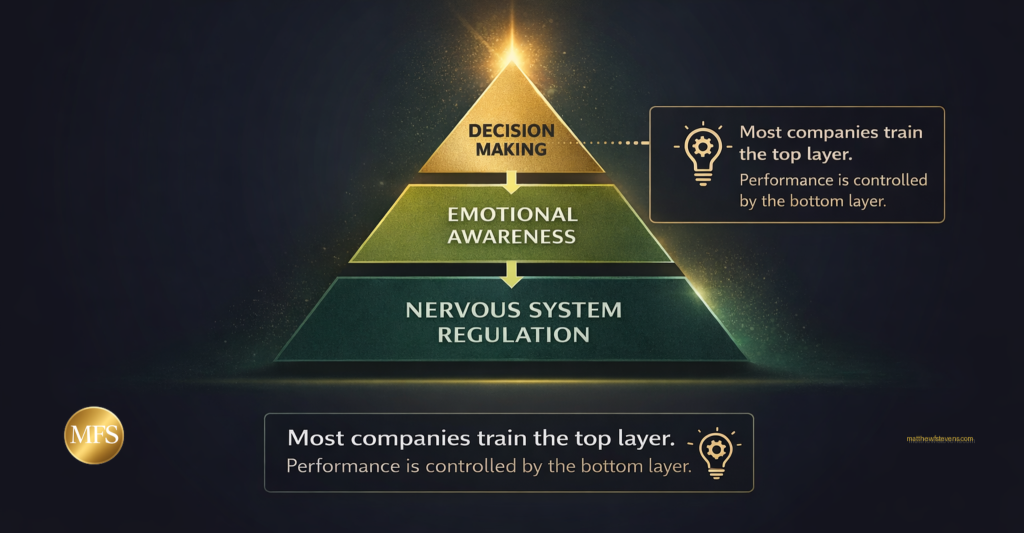
Most people believe high performance begins with mindset, discipline, or knowledge.
It doesn’t.
High performance begins with regulation.
The Moment I Realized I Wasn’t Regulated
About a year after being separated from my family, I realized how much trouble I was in. Before that moment, I was doing everything I could to maintain a sense of normalcy. I was working. Staying busy. Learning constantly.
From the outside, it looked like I was functioning.
What I didn’t realize was that my nervous system was in a constant state of activation.
At the time, I could clearly see when others were emotionally dysregulated. What I couldn’t see was my own state. I was everywhere. Working constantly. Solving problems. Moving forward.
But internally, I was rushed.
That rushed state followed me everywhere.
Even on the golf course.
I knew exactly what I needed to do to make solid contact with the ball. Keep my eye on it. Stay present. Execute the swing.
But I couldn’t.
Not because I lacked knowledge. Because I lacked regulation.
My nervous system was operating as if something was wrong—even when nothing was wrong.
That was the moment everything changed.
For the first time, I became aware of my internal state. I could feel my heartbeat. I could observe my reactions. I began asking a simple question:
How many of my behaviors were driven by a dysregulated nervous system?
The answer was uncomfortable.
Most of them.
I had spent years accumulating knowledge about growth, discipline, and success. But knowledge alone didn’t create change.
Regulation did.
As my nervous system became more regulated, everything improved.
My focus improved.
My decision-making improved.
My performance improved.
I became more consistent—not because I learned something new, but because I was finally able to apply what I already knew.
The Sequence Behind High Performance
This realization became the foundation for everything I build today.
Operational Regulation Systems (ORS™).
Neuro Advanced Learning Systems (NALS™).
EQ Unlocked.
All of them exist for one reason:
Regulation creates access.
When a person is regulated, awareness becomes clear.
When awareness becomes clear, better choices follow naturally.
This is the sequence:
Regulation → Awareness → Choice
This is RAC — the sequence underneath ORS™ (Operational Regulation Systems).
Not the other way around.
Most people try to change their choices first.
But choice is unavailable without awareness.
And awareness is unavailable without regulation.
High performance is not created by forcing better behavior.
It is created by stabilizing the nervous system that drives behavior.
When regulation improves, performance follows.
Not through force.
Through access.
— Matthew F. Stevens
Creator of ORS™, NALS™, and EQ Unlocked
Frequently Asked Questions
Why does emotional regulation matter more than mindset or discipline for performance?
Because mindset and discipline are only accessible when the nervous system is regulated. A dysregulated nervous system can hold all the right knowledge and still fail to apply it consistently under pressure.
What does it feel like to be dysregulated without realizing it?
It can look like functioning normally from the outside — working, staying busy, solving problems — while internally operating in a constant state of activation, as if something is wrong even when nothing is.
What is the RAC (Regulation → Awareness → Choice) sequence?
It’s the order in which real behavior change actually becomes available: regulation has to come first, because awareness only becomes clear once the nervous system is stable, and better choices only become possible once awareness is clear.
How is this different from just trying harder to change behavior?
Forcing better behavior directly skips the step that makes it sustainable. Stabilizing the nervous system that drives the behavior creates lasting access to better choices, rather than a short-term act of willpower.
Leave a Reply