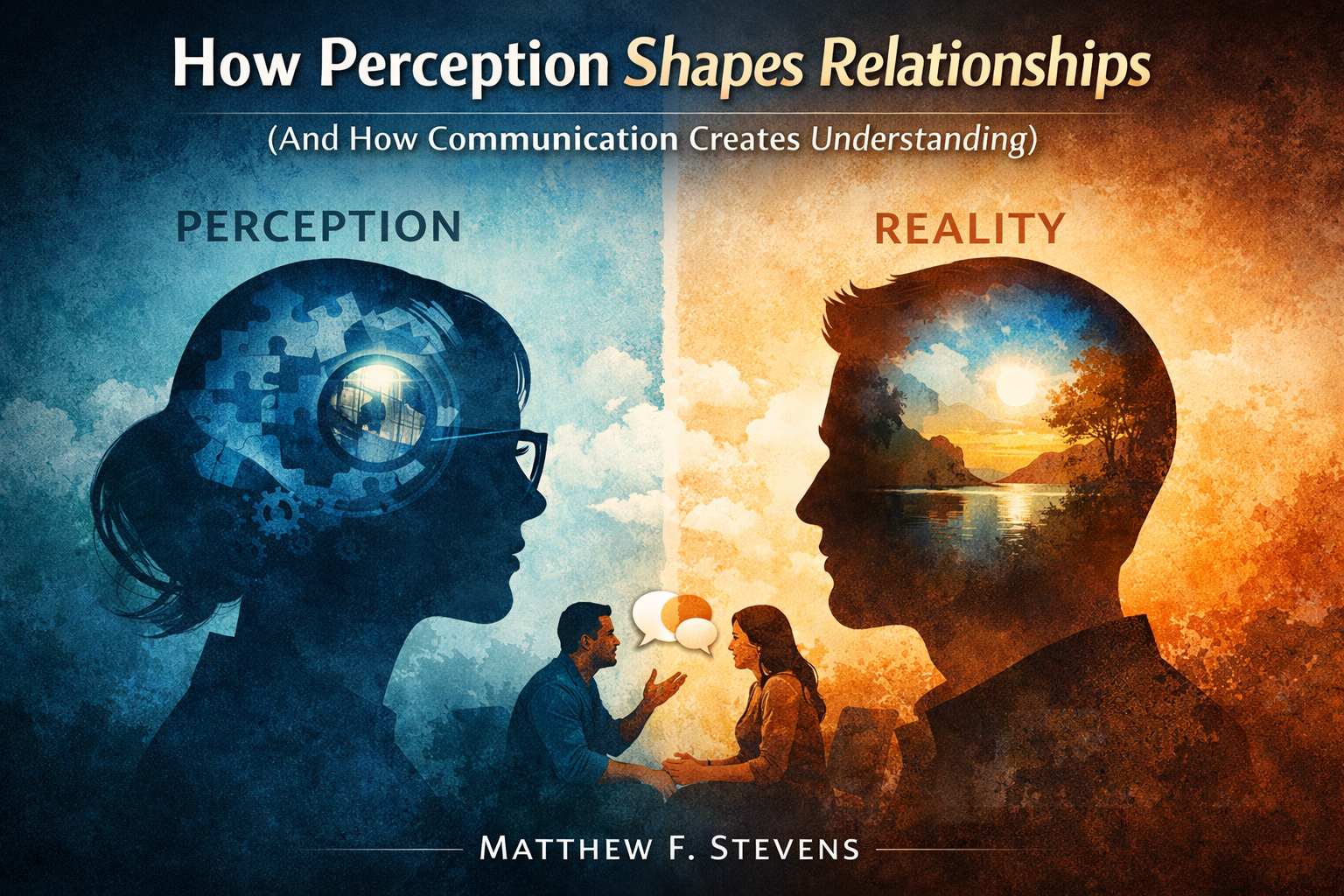
Perception shapes relationships and plays a powerful role in how people interpret conversations, behaviors, and emotional signals.
Every relationship is shaped by two forces:
Reality… and perception.
Reality is what actually happens.
Perception is the meaning we assign to what happens. It is the lens through which we interpret conversations, actions, tone, and even silence.
Differences in perception are normal. No two people see the world exactly the same way.
The real challenge in relationships begins when assumptions replace communication.
When we assume we understand how someone feels, what they meant, or what they expected, we begin reacting to our interpretation instead of their actual experience.
Over time, this creates misunderstanding.
Not because of what was said…
But because of what was never clarified.
Perception Shapes Relationships – Misunderstandings
Many misunderstandings in relationships occur when people respond to what they think someone meant instead of asking for clarity.
Human communication is complex. Research in communication studies suggests that words represent only a small portion of how messages are received; tone, body language, and emotional state often carry much more meaning in a conversation. Understanding someone requires more than hearing their words — it requires being present for the entire interaction.
To truly understand another person, we must pay attention not only to what is said, but how it is said.
Presence allows us to notice when we are interpreting rather than understanding.
The Solution: Curiosity Instead of Assumption
The solution to perception problems in relationships is not controlling how others think.
The solution is creating clarity through communication.
This begins with curiosity.
When we notice ourselves forming assumptions, we can pause and ask a simple question:
“Can I make sure I understand what you meant?”
That moment of curiosity often prevents misunderstandings from growing into conflict.
Healthy relationships are not built on identical perspectives.
They are built on shared understanding.
Shared understanding requires communication, patience, and emotional awareness.
These are foundational components of emotional intelligence.
If emotional awareness is something you are developing, you can explore the Regulation Baseline Assessment to better understand how emotional regulation influences perception and decision-making.
Emotional Intelligence and Relationship Clarity
Emotional intelligence helps people recognize when perception is shaping their reactions.
When individuals learn to regulate emotional responses, they gain the space needed to ask questions instead of reacting automatically.
This shift changes relationships.
Instead of responding to assumptions, people begin responding to understanding.
Instead of reacting to interpretations, they respond to reality.
According to research summarized by Daniel Goleman, emotional intelligence plays a major role in how individuals navigate relationships, manage conflict, and communicate effectively.
The ability to pause, reflect, and ask questions strengthens trust and deepens connection.
Choosing Understanding
Most conflicts in relationships are not caused by bad intentions. Perception shapes relationships and as a consequence our perception must be aligned.
They are caused by unexamined perceptions.
When we replace assumptions with curiosity, something powerful happens.
Clarity grows.
Trust strengthens.
And relationships become spaces where understanding can develop instead of places where misunderstandings quietly take root.
The goal is not to eliminate perception.
The goal is to recognize perception and choose communication.
That choice creates stronger relationships, clearer conversations, and deeper human connection.
Understanding perception in relationships allows people to replace assumptions with communication and build deeper trust.
— Matthew F. Stevens
Leave a Reply