Tag: performance under stress
  • How Perception Shapes Relationships (And How Communication Creates Understanding)

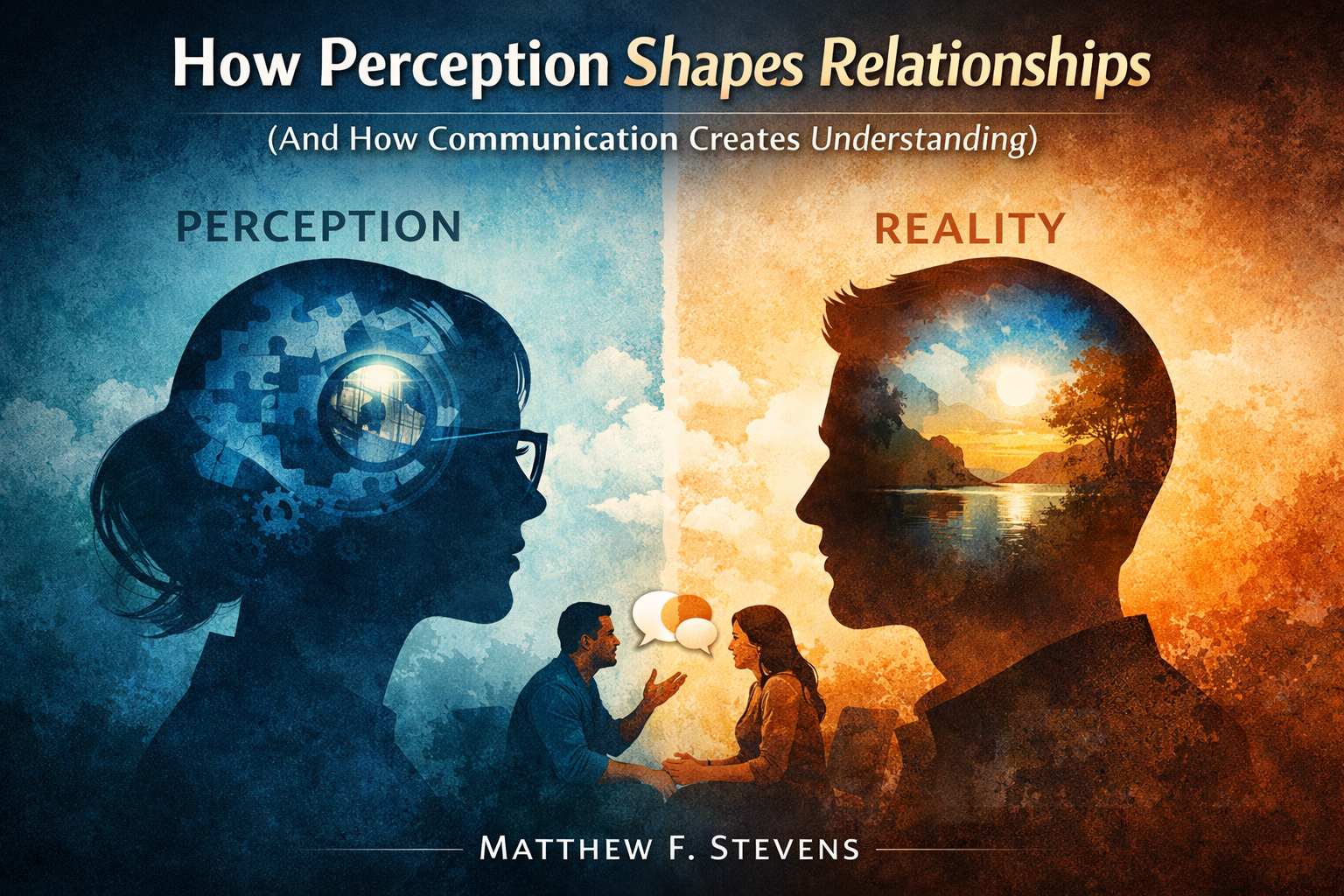
    How Perception Shapes Relationships (And How Communication Creates Understanding)

    Perception shapes relationships and plays a powerful role in how people interpret conversations, behaviors, and emotional signals.

    Every relationship is shaped by two forces:

    Reality… and perception.

    Reality is what actually happens.

    Perception is the meaning we assign to what happens. It is the lens through which we interpret conversations, actions, tone, and even silence.

    Differences in perception are normal. No two people see the world exactly the same way.

    The real challenge in relationships begins when assumptions replace communication.

    When we assume we understand how someone feels, what they meant, or what they expected, we begin reacting to our interpretation instead of their actual experience.

    Over time, this creates misunderstanding.

    Not because of what was said…

    But because of what was never clarified.

    Perception Shapes Relationships – Misunderstandings

    Many misunderstandings in relationships occur when people respond to what they think someone meant instead of asking for clarity.

    Human communication is complex. Research in communication studies suggests that words represent only a small portion of how messages are received; tone, body language, and emotional state often carry much more meaning in a conversation. Understanding someone requires more than hearing their words — it requires being present for the entire interaction.

    To truly understand another person, we must pay attention not only to what is said, but how it is said.

    Presence allows us to notice when we are interpreting rather than understanding.

    The Solution: Curiosity Instead of Assumption

    The solution to perception problems in relationships is not controlling how others think.

    The solution is creating clarity through communication.

    This begins with curiosity.

    When we notice ourselves forming assumptions, we can pause and ask a simple question:

    “Can I make sure I understand what you meant?”

    That moment of curiosity often prevents misunderstandings from growing into conflict.

    Healthy relationships are not built on identical perspectives.

    They are built on shared understanding.

    Shared understanding requires communication, patience, and emotional awareness.

    These are foundational components of emotional intelligence.

    If emotional awareness is something you are developing, you can explore the Regulation Baseline Assessment to better understand how emotional regulation influences perception and decision-making.

    Emotional Intelligence and Relationship Clarity

    Emotional intelligence helps people recognize when perception is shaping their reactions.

    When individuals learn to regulate emotional responses, they gain the space needed to ask questions instead of reacting automatically.

    This shift changes relationships.

    Instead of responding to assumptions, people begin responding to understanding.

    Instead of reacting to interpretations, they respond to reality.

    According to research summarized by Daniel Goleman, emotional intelligence plays a major role in how individuals navigate relationships, manage conflict, and communicate effectively.

    The ability to pause, reflect, and ask questions strengthens trust and deepens connection.

    Choosing Understanding

    Most conflicts in relationships are not caused by bad intentions. Perception shapes relationships and as a consequence our perception must be aligned.

    They are caused by unexamined perceptions.

    When we replace assumptions with curiosity, something powerful happens.

    Clarity grows.

    Trust strengthens.

    And relationships become spaces where understanding can develop instead of places where misunderstandings quietly take root.

    The goal is not to eliminate perception.

    The goal is to recognize perception and choose communication.

    That choice creates stronger relationships, clearer conversations, and deeper human connection.

    Understanding perception in relationships allows people to replace assumptions with communication and build deeper trust.

    Matthew F. Stevens

  • The Hidden Reason Performance Under Stress Fails (What Most People Miss)

    The Hidden Reason Performance Under Stress Fails (What Most People Miss)

    Performance under stress is where many capable people suddenly break down. The issue is rarely a lack of training or knowledge. More often, it is the nervous system’s response to repeated stressful events. Most people try to improve performance by focusing on the outcomes they can measure.

    Productivity.
    Results.
    Metrics.
    Performance numbers.

    These things matter. They help us understand what is happening.

    But they are outcomes, not causes.

    When performance starts to decline, most people try to correct themselves. They push harder, work longer hours, or try to control behavior more tightly.

    What often goes unnoticed is something deeper:

    The role the nervous system plays in human performance.

    Understanding how stress affects the nervous system can completely change the way we think about emotional intelligence, leadership, and performance.


    When I First Saw the Pattern

    Years ago, I worked closely with young people who had experienced significant trauma. Performance under stress is an understatement.

    One of them was a young man named Dustin.

    I recently shared his story as the first case study on the EQ Unlocked podcast because his experience illustrates something I would later see repeated in many different environments.

    To many people, Dustin was difficult to work with. He was rough around the edges, stubborn, and at times openly defiant. Many people expected confrontation whenever he walked into a room.

    But over time something began to change.

    As Dustin and I continued working together, trust slowly developed between us. The more that trust grew, the more his behavior began to soften.

    The defiance people saw so clearly started to fade.

    His rough exterior softened.

    What stood out most to me was that this shift did not happen because Dustin suddenly learned new behavioral skills.

    It happened because something else changed.

    The calmer I remained—regardless of how he behaved—the more Dustin realized that the defenses he used to keep people at a distance were not necessary with me.

    His nervous system began to settle.

    And once that happened, everything else became easier.


    What Most People Miss About Emotional Regulation

    What I eventually realized was that Dustin did not lack awareness.

    He lacked regulation.

    When his nervous system was overwhelmed, his behavior became reactive. But when his nervous system was able to settle, something very different appeared.

    He became thoughtful.

    More cooperative.

    More open.

    The same person was there the entire time.

    What changed was his level of nervous system regulation.

    This insight completely changed the way I understood emotional intelligence.

    Stress responses are not only psychological; they are deeply physiological. In a class I attended taught by psychiatrist Bessel van der Kolk, I learned how the nervous system reacts to stress long before conscious thought has time to intervene. In his book The Body Keeps the Score, he explains how the body and nervous system store and respond to stress long before the thinking brain can catch up. When the nervous system becomes overwhelmed, performance often breaks down regardless of training or intention. This is why regulation matters. If the nervous system becomes overwhelmed first, awareness and choice often arrive too late.


    The Same Pattern Shows Up Everywhere

    Years later, I began noticing the same pattern in professional environments.

    Different setting.

    Same mechanism.

    Customer service agents who handled several difficult calls in a row would suddenly struggle to maintain the same patience and clarity they showed earlier in the day.

    Leaders managing constant pressure would begin reacting faster and thinking less clearly as stress accumulated.

    Most people interpret these situations as performance problems.

    But often the deeper issue is something else.

    Stress events are occurring faster than the nervous system can recover.

    When that happens, emotional regulation becomes more difficult, and performance begins to destabilize.


    Why More Training Often Doesn’t Solve the Problem

    Many people assume that performance problems can be solved simply by increasing awareness or providing more training.

    Training can be valuable. It increases knowledge and builds skills.

    But training assumes something important:

    That people will be able to access those skills under stress.

    When the nervous system becomes overwhelmed, access to higher-level thinking becomes limited.

    This is why people often know exactly what they should do but still struggle to do it in the moment.

    The issue is not knowledge.

    The issue is recovery between stress events.


    Stabilizing Performance Under Stress

    In high-pressure environments, stress events happen repeatedly throughout the day.

    A difficult conversation.

    An unexpected problem.

    A demanding interaction.

    Each of these events activates the nervous system.

    If recovery between those events happens quickly, performance remains stable.

    But when stress accumulates faster than the nervous system can recover, something begins to change.

    Reactions become quicker.

    Patience becomes thinner.

    Performance becomes inconsistent.

    What most people miss is that improving performance often requires stabilizing the human system behind the performance. I later built a structured approach to this problem through Operational Regulation Systems (ORS).


    The Foundation of Emotional Intelligence

    Many conversations about emotional intelligence focus on awareness.

    Others focus on decision-making.

    But something comes before both.

    Regulation.

    Because when the nervous system is stable, awareness improves.

    And when awareness improves, people make better choices.

    That sequence can be summarized simply:

    Regulation → Awareness → Choice

    Understanding this principle can fundamentally change the way we approach leadership, performance, and emotional intelligence.

    Because when the human system stabilizes, performance often stabilizes with it.


    Dustin’s Story

    Dustin’s story is explored in more detail in the EQ Unlocked Podcast, where I discuss how nervous system regulation shapes behavior, emotional intelligence, and performance under stress.