Recently, I took a friend to the ER after she fell down a set of stairs.
The doctor was dismissive.
Not aggressive. Not rude. Just… uninterested.
And to be fair—I understand the pressure.
Emergency rooms are high-stress environments.
Decisions are fast. Time is limited. Volume is constant.
But here’s the problem:
Pressure does not excuse disconnection.
Because when a patient feels dismissed, they stop listening.
And when they stop listening, care breaks down.
The Hidden Problem in Doctor-Patient Communication
This wasn’t an isolated experience.
I’ve seen it before—and I’ve experienced it myself.
Medical professionals often focus on the presenting problem:
- The injury
- The symptom
- The immediate concern
But they miss something just as important:
What brought the person there in the first place.
Instead of listening, the interaction becomes transactional—efficient, but disconnected.
And for someone with a trauma history, that moment lands differently.
It doesn’t feel efficient.
It feels like dismissal.
This is where doctor-patient communication begins to break down—especially when trauma-informed care in healthcare is missing.
Why Trauma-Informed Care in Healthcare Matters
Trauma-informed care in healthcare is not just about being kind—it’s about understanding how past experiences shape present behavior.
When patients feel unsafe, unheard, or judged, their nervous system responds.
They shut down.
They withhold information.
They disconnect.
Without trauma-informed care, providers risk treating symptoms while missing the underlying cause. More about this issue https://pmc.ncbi.nlm.nih.gov/articles/PMC4910305/?utm_source=chatgpt.com
How Dysregulation Impacts Patient Outcomes
Let’s call it what it is.
This isn’t a knowledge problem.
This is a regulation problem.
When a medical professional is under constant pressure, their nervous system adapts.
It prioritizes:
- Speed
- Task completion
- Throughput
And slowly, without intention, something gets lost:
Presence.
Dysregulation doesn’t always look chaotic.
Sometimes it looks like efficiency without connection.
Internally, it sounds like:
- “I don’t have time for this.”
- “Let’s get to the point.”
- “What’s the issue?”
But to the patient, it translates to:
“I don’t matter.”
The Cost of Assumption in Medical Settings
When people don’t feel heard, they don’t open up.
They withdraw.
They shorten their answers.
Or they become frustrated.
Either way—the real issue stays hidden.
In this case, yes—my friend injured her ankle.
But that wasn’t the full story.
She had been dealing with a severe cough for weeks.
She had seen multiple providers.
She had been given multiple medications.
None of them worked.
The actual issue?
An infection that required a completely different approach.
We almost missed it.
Not because of a lack of knowledge—
Because of a lack of connection.
Regulation: The Missing Link in Patient Centered Care
Medical training builds knowledge.
Experience builds pattern recognition.
But neither matter if they aren’t accessible under stress.
Nervous system regulation in healthcare is what makes both usable.
When providers operate from a regulated baseline:
- They listen instead of rush
- They get curious instead of assume
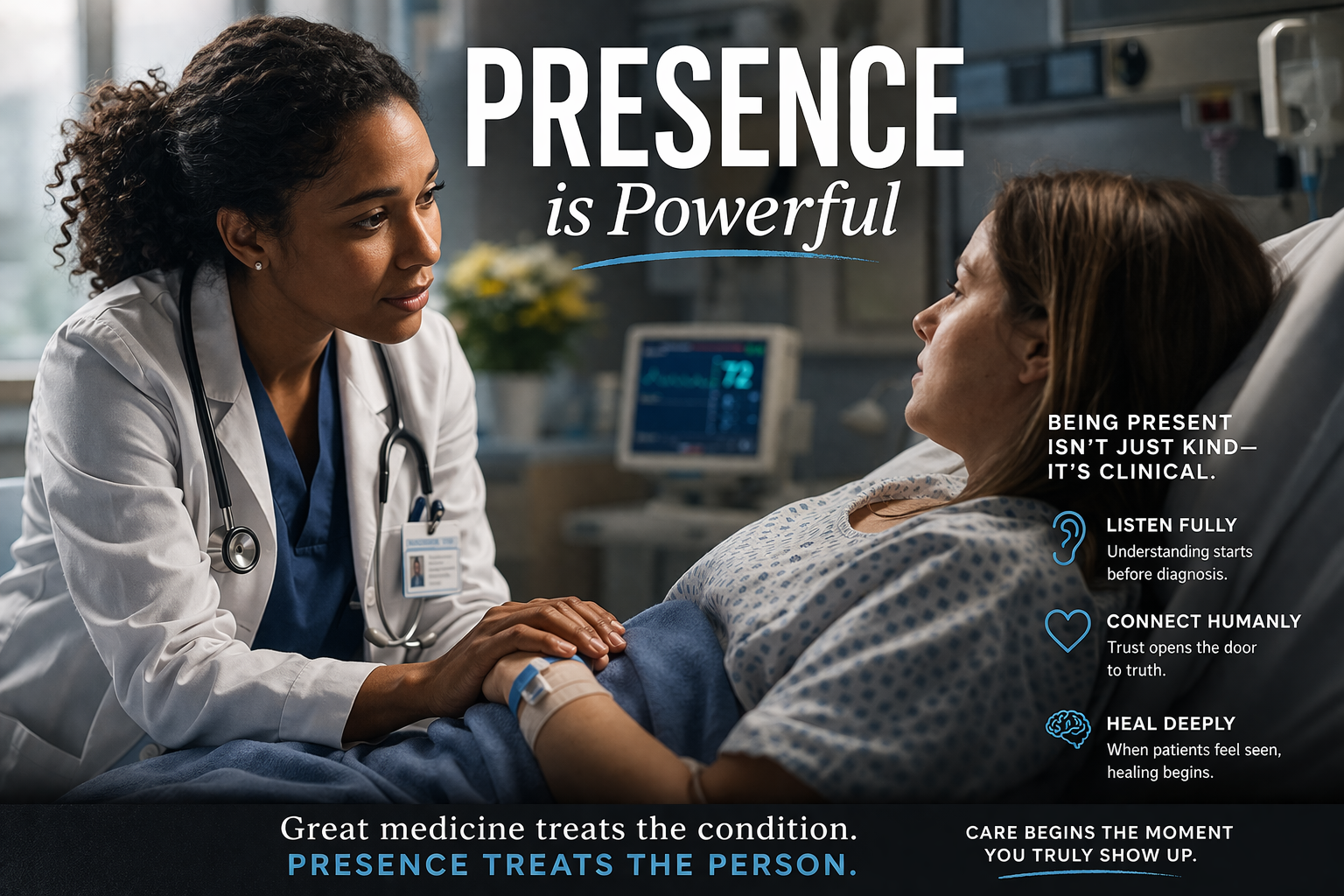
- They connect before they diagnose
Even something simple—like reflecting a patient’s words back—can transform the interaction.
This is the foundation of true patient-centered care.
Improving Healthcare Communication Through Regulation
Stress in healthcare isn’t going away.
But how it’s handled?
That’s trainable.
When regulation improves:
- Doctor-patient communication improves
- Diagnosis becomes more accurate
- Patient trust increases
- Outcomes improve
And just as importantly—
Providers experience less internal strain.
The Standard Moving Forward
This isn’t about blame.
It’s about awareness.
Because the difference between assumption and understanding
is often just a regulated moment.
Closing
If you’ve ever felt dismissed, unheard, or judged in a medical setting—
Understand this:
That experience didn’t start with you.
It started with a system operating under pressure
without addressing the human mechanism behind it.
And that mechanism is the nervous system.
When we begin addressing the nervous system from the moment a patient walks through the door, something shifts:
Connection improves.
Trust builds.
Healing begins.
I have family members in the medical field, and I’ve heard the pressure they carry.
The solution isn’t removing stress.
It’s learning to operate effectively within it.
Regulation → Awareness → Choice
If you want to understand where you are in this process, take the Regulation Baseline:
https://nals.io/
Leave a Reply