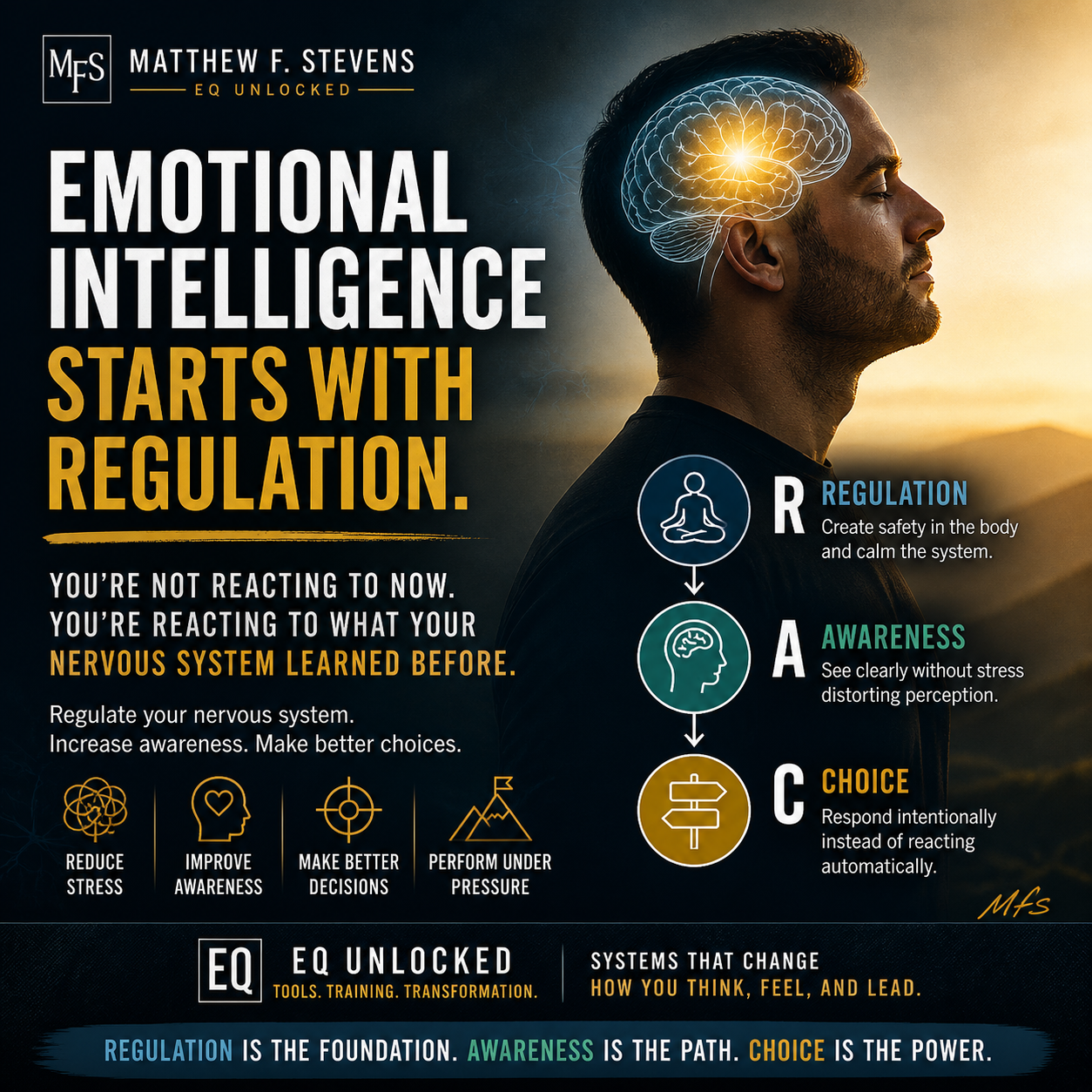
Most people think emotional intelligence is about communication skills, staying calm, or learning how to “manage emotions.”
But emotional intelligence begins much deeper than behavior.
It begins with regulation.
Before someone can communicate clearly, make healthy decisions, or respond intentionally under pressure, their nervous system has to feel safe enough to allow awareness to exist without becoming overwhelmed.
That changes everything.
Why People Repeat the Same Patterns
Many people are not reacting to the present moment.
They are reacting to what their nervous system learned through repeated experiences over time.
Stress. Rejection. Chaos. Criticism. Instability. Fear.
Over time, the body learns survival patterns:
- shutting down
- overreacting
- people pleasing
- emotional withdrawal
- anger
- avoidance
- hypervigilance
- impulsive decision-making
These responses are often mislabeled as personality flaws when they are actually conditioned nervous system responses.
You cannot build lasting emotional intelligence while your body still believes survival is the priority.
Awareness Without Regulation Can Feel Overwhelming
This is where many people struggle.
They become aware of their patterns, trauma, triggers, or behaviors—but awareness alone does not create change.
In fact, awareness without regulation often increases shame, anxiety, frustration, or emotional flooding.
That is why the order matters:
REGULATION → AWARENESS → CHOICE
When the nervous system becomes more regulated:
- reactions slow down
- thinking becomes clearer
- self-awareness improves
- communication changes
- behavior becomes more intentional
The goal is not emotional perfection.
The goal is to create enough internal stability to choose differently rather than react automatically.
Emotional Intelligence Is Built Through Repetition
Real emotional intelligence is not built through motivation alone.
It is built through repeated experiences that teach the nervous system:
- safety
- consistency
- self-respect
- accountability
- emotional recovery
- pause before reaction
Small repeated behaviors reshape baseline responses over time.
This is why consistency matters more than intensity.
Tiny repeated choices:
- taking a breath before reacting
- pausing instead of escalating
- communicating clearly
- maintaining boundaries
- following through on commitments
- staying present under stress
gradually recondition the nervous system.
That is how emotional intelligence becomes embodied instead of intellectual.
Emotional Intelligence Changes Every Area of Life
When regulation improves, people often notice changes in:
- relationships
- leadership
- parenting
- performance under pressure
- confidence
- discipline
- communication
- self-respect
Not because they became a different person overnight—
but because they stopped operating from constant survival mode.
A dysregulated nervous system distorts perception.
A regulated nervous system increases clarity.
Emotional intelligence impacts every area of life—from leadership and communication to stress management, relationships, and decision-making under pressure. Publications like Forbes continue emphasizing emotional intelligence as a critical factor in both personal and professional success.
The Future of Emotional Intelligence
The future of emotional intelligence is not just learning how to think differently.
It is learning how to regulate differently.
The more we understand the relationship between the nervous system, behavior, awareness, and decision-making, the more we realize:
People are not weak because they struggle.
Many have never learned regulation.
And once regulation improves, awareness sharpens.
When awareness sharpens, choices change.
That is where transformation begins.
Get your regulation baseline assessment here.
Matthew F. Stevens
Founder of NALS™, ORS™, and EQ Unlocked
Helping individuals and organizations build emotional intelligence through nervous system regulation and structured behavioral systems.
